


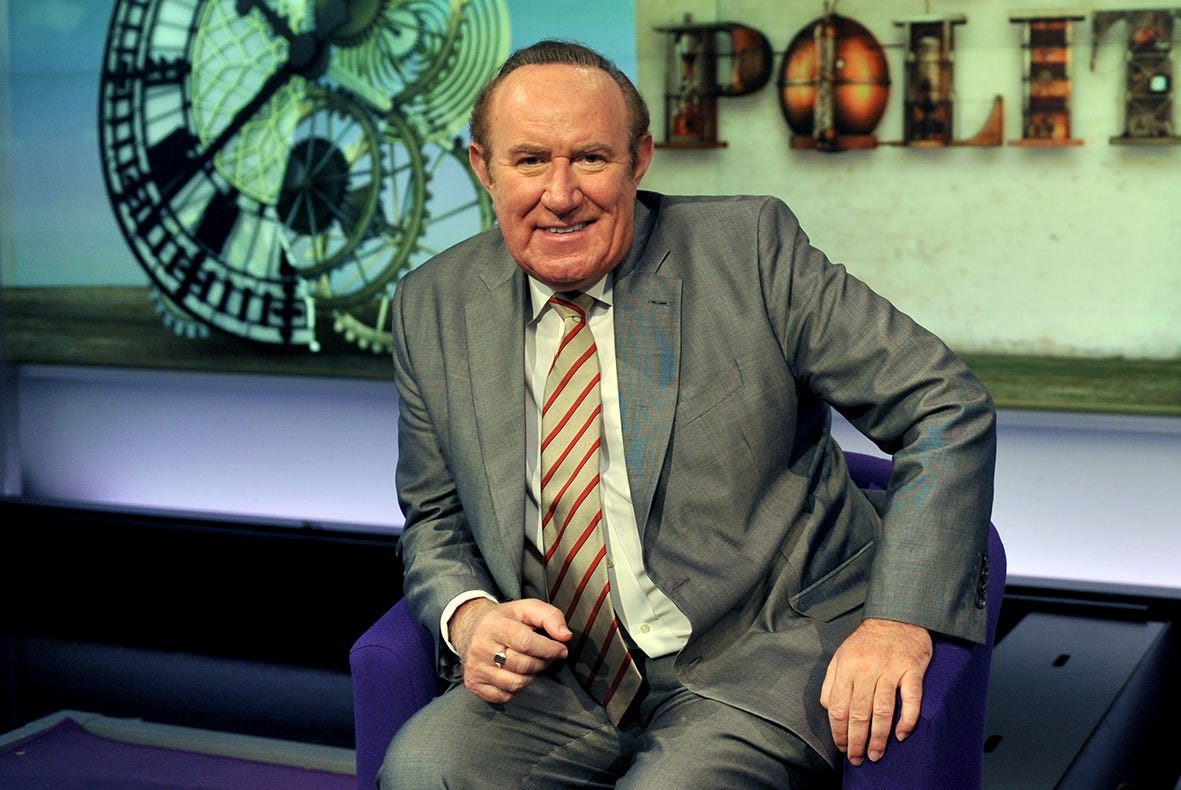
Andrew Neil is one of Britain’s most recognisable conservative pundits, and has been for close to half a century.
Entering journalism in 1973 as a correspondent for The Economist, Andrew has since worked at many of Britain’s most prestigious and widely circulated news organisations. His credits include the Sunday Times, the Daily Mail, Sky TV, the BBC, Channel 4 and GB News.
Today, he hosts a daily broadcast for Times Radio.
Why did we invite him on?
In his 50+ year career, Andrew has seen and reported on more news than most people currently alive. With that, he has garnered a level of experience that is exceedingly rare in this business. Naturally, we’ve wanted to pick his brains for some time.
What does he make of the current state of Britain? How does he assess Burnham’s promises? What does he think our future holds?
What did we talk about?
”There’s a lot happening in the country. Unfortunately, very little of it is good.”
This, we don’t need to tell you, is hardly an original view. Bad news typically leads because it’s the news worth knowing, and consuming that 24/7 is going to colour one’s view of the country and indeed the world. But is that a fair-minded approach? To invite the obvious, we ask: what has him so pessimistic?
”We head into winter with rising interest rates, rising inflation, rising mortgage rates, no end in sight for Trump’s war in Iran, a new cost-of-living crisis coming down the pike with rising energy bills, and a political system that doesn’t know how to handle it.”
So, no easy fixes. As depressing as it sounds, it’s equally refreshing; in a time when endless politicians, pundits and talking heads parrot the same “solutions” to multi-dimensional problems, Andrew recognises that things are more complex and demanding than is often made out.
However, that shouldn’t excuse those who put their head in the sand. On the long list of figures doing exactly that, he points squarely at our new Prime Minister: Andy Burnham.
To some on the left, Burnham is the great white hope they’ve been waiting for. A more likeable, principled successor to Starmer who can inherit his powerful majority and use it to actually instigate the left-wing vision once promised. This, Andrew suggests, is a misreading.
”Mr Burnham has nothing to say about the winter we have coming. It was all about the next manifesto, and how he has a miner’s lamp on his shelf… This curious mixture of nostalgia and folklore that dominates the Labour Party. No plan for dealing with all the things we’re discussing… None of that has been done.”
Starmer was often accused of being a technocrat - a leader who over-indexed the ‘practical’ aspect of politicking rather than the principled or ethical. Andrew paints Burnham as the opposite: a PM too swept up in nostalgia for a fictitious past to realise the very real problems his nation faces.
”When we already have the highest tax burden ever in peacetime, yet he wants to increase the tax burden. Rather than looking at the state, deciding what it can actually do and making sure it does it well, he wants the state to do everything.”
It’s hard to blame Burnham for that specifically; this is the British political status quo, and has been for some time. Whoever is in power, spending goes up, the debt increases, and the state somehow becomes more sluggish. And we’re not the only ones.
”Britain’s not alone in this. In America, fiscal conservatism is dead. Nobody talks about it, not on either side! Their debt has just passed 40 trillion. I don’t even know what that means. I was speaking with Reagan once, and he said to me: ‘Andrew, a billion here, a billion there, it soon adds up to real money!’ Now it’s a ‘trillion here, a trillion there’ [laughs].”
Konstantin is a self-described accelerationist: let things get as bad as they need to for people to make the changes they should have made long ago. Whether that be illegal immigration, the debt, energy costs, housing prices… Eventually, the situation will become so untenable, the public will no longer stand for it. One only hopes they will react peacefully.
Is that a credible position? According to Andrew, yes, but ultimately, no.
