


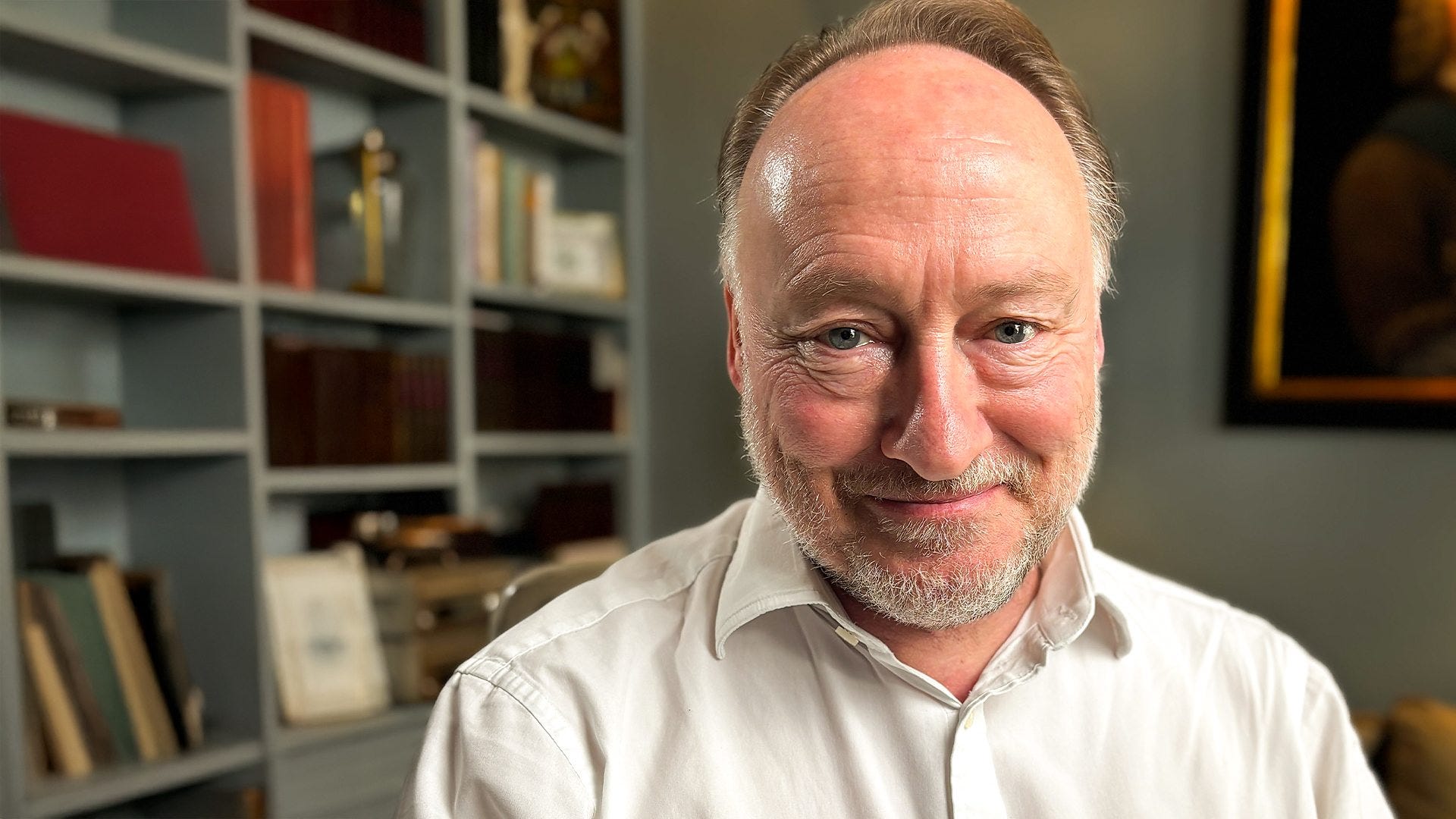
Few figures are more respected in their respective fields than Andrew Roberts is in his; he is a historian’s historian.
Since publishing his first book in 1991, he has written dozens of acclaimed texts, written even more columns for the national broadsheets, and spoken to hundreds of academic and institutional organisations, including for presidents and royalty.
After years as something of a cult figure, Andrew came to wider prominence in 2009 with the release of his modern classic The Storm Of War, a best-selling tome that charted the rise of Hitler and the administration behind Nazi Germany.
Since then, he has continued to establish his reputation as one of the great living historians through his work on royalty, aristocracy, and Sir Winston Churchill, of whom he is thought to be the world’s leading expert.
Why did we invite him on?
In March 2024, we welcomed Andrew onto our show to explore the legacy of Churchill, in a two-hour interview that, at the time of writing, has just shy of a million views. It was a sublime conversation. We instantly knew that, when the right opportunity arose again, we’d be having him back.
Another of Andrew’s figures of expertise is a man who, in many ways, is similar to Churchill. A globe-changing European statesman for whom the archetype of ‘leader’ is made in their image.
Napoleon.
His 2014 book Napoleon: A Life, stretching across nearly a thousand pages, is frequently cited as the finest book ever penned on its subject. When deciding what to explore in our next interview, he seemed a natural choice.
The standard was set last time. It’s no exaggeration to say this conversation may have been even more revelatory.
What did we learn?
Some topics are so vast, it’s difficult to know where to start, and unravelling the “great men of history” is a universally knotty task. The centuries that follow them are made, directly or not, in their image. Is that even the right way to comprehend them? How does one even begin trying to understand Napoleon?
”Napoleon famously said that if you observe a man at 20 and how the world is at that age, you’ll understand the rest of the man’s life. When he was 20, the French Revolution was in full swing, and he saw an opportunity. Soon, many of the senior positions in the army would be vacated, as the men who held them were guillotined. He knew he could rise to a very high position very quickly, and he did; he was a general before he was 24.”
As Andrew explains, Napoleon found himself at the heart of some unusual circumstances, ones inseparable from his story. Born to nobility but impoverished later in life, he had a peculiar skill set paired with unusual conditions - he was underestimated and overlooked, but highly capable. And he knew it.
”He had a great sense of his own abilities. He had a high opinion of himself, but he was also immensely talented and extremely hard-working.”
Still, greatness isn’t just a matter of time or place - the man must meet the moment. And Napoleon certainly did; if it weren’t the genius of his strategy, his renegade approach to tactics, we wouldn’t be here having this conversation now. In the 21st century, his name is shorthand for “conflict mastermind.”
So, how did he get that reputation? What were his revolutions in the domain of war?
”He ripped up the rulebook completely.
