


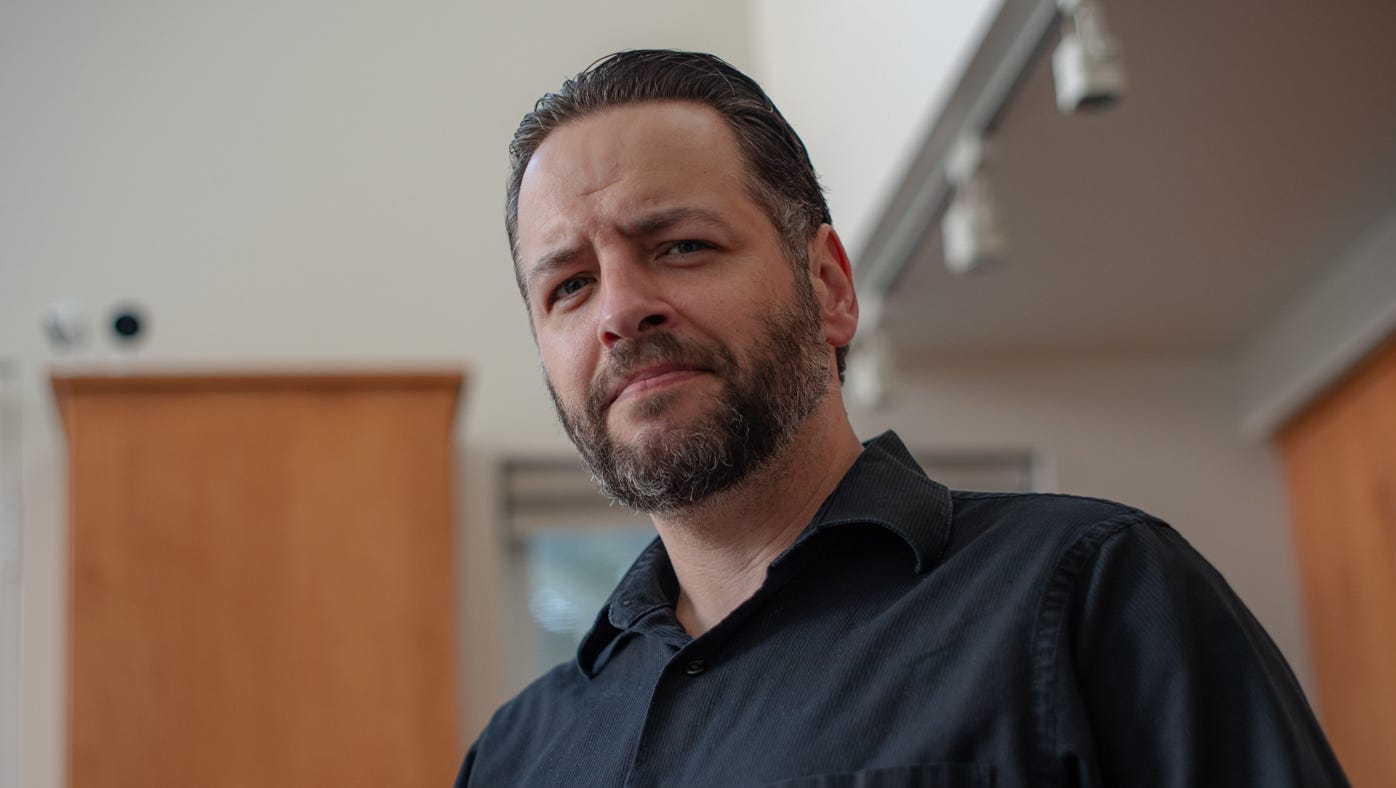
”When you start looking at the underpinnings of our beliefs, you realise how we divided we are. There’s a lot more hatred than you think.”
Andrew Wilson is one of the internet’s most notorious debaters and not without good reason. His confrontational and arresting style, as demonstrated through his appearances on Piers Morgan Uncensored and the Whatever podcast, has earned him fans and detractors alike. More recently, Andrew has appeared on Jubilee’s flagship show Surrounded, where he faced off against left-wing streamer Destiny, and on the Joe Rogan Experience. Today, he hosts his own podcast The Crucible, which has been described as “the fastest growing debate platform online”.
Why did we invite him on?
Andrew is a voice in ascent. While most well-known pundits initially made their name in other fields - authoring books, stand-up, commentating, etc. - Andrew’s reputation is built purely on his skills in the arena of debate.
That alone makes him interesting. But we were intrigued beyond that.
Andrew’s politics - what he describes to us as a form of cultural nationalism informed by Christian ethics - are also becoming increasingly popular. His right-populist stances have been taken up by some of the most influential conservatives in the world today, and we wanted to explore those maxims with one of their most ardent apologists.
Yet, for as much as we put our challenges to Andrew, he returned some tests of his own.
What did we talk about?
Well, things start off blunt.
”I hate leftists.”
Why?
”They’re psychopaths who are going to destroy everything I care about through suicidal empathy. I hate the entire left. I consider the delineation between progressives and leftists to be minute. It’s all about ethics and they don’t have any. It’s just degrees of psychopathy.”
If Andrew’s expecting an argument about the demerits of lunatic progressivism, he’s come to the wrong place. But why throw all left-wing people in the same bucket? There are plenty of sane left-wing thinkers - many of whom we’ve had on the show - who don’t hate their country or success or merit and are willing to hear the other side and consider the issues with an open mind and humility.
Andrew doesn’t think so.
”It’s all the same kind of thinking. Why do they want what they want? Why aren’t social safety nets voluntary? The whole idea of progressive liberalism is volunteerism, that the government can’t force you to do anything. The promise of leftists, of progressives, is that the government will do what’s fair. That’s why we can’t have a Christian government, because the secularists will do what’s fair. They’re not going to force you to do anything, but they compell me against my will to do all kinds of things.”
Still, there are degrees here. A centre-left thinker might argue for raising taxes a fraction, or opening more community centres, providing a more robust safety net. This is a far cry from the communist who wants totalitarian control of the economy, the press and the means of production.
It’s true, Andrew concedes, but fundamentally, the difference is not meangingful.
”Right and left is dialectical. We view politics in the United States through a duality - it’s left, or it’s right … What are we referencing here? What is ‘left’? Is it social issues? Is it taxes? … I think we could break it down further - these are philosophical positions and people don’t realise it.”
What does Andrew mean by that?
”The left-wing pillar is based around anti-realism and anti-moralism. That’s how you end up with post-modernism and all that. Right-wingers are interested in tradition and religion because they see the world as duty-bound, [whereas] the left see it as about ‘rights’. ‘I have the right to do this, I have the right to do that.’ There are no morals - it’s all stance dependent - which is why they do so many immoral things. Those pillars don’t align, and that’s why we’re constantly clashing.”
If you hadn’t worked it out already, Andrew finds himself squarely on the right. A self-described “paleocon” (conservative in the traditional sense), he appeals to the value of an objective standard. To Andrew, moral relativism is a downward spiral to degeneracy and apathy.
Konstantin challenges him, asserting that, in a liberal society, Andrew is welcome to have his views on any given subject. The only limit is when he tries to move from the philosophical to the political - when he tries to thrust his personal qualms on the wider population. Andrew responds, arguing that these two things are not too different and, in practice, might even be indistinct.
”If there’s no objective appeal to a standard, then everything’s fair game, and then things are eroded… OnlyFans hookers and homosexual marriage, why is this something we have to put up with again? If two men can get married, why not three? Why not ten? Nothing. Nothing prevents that. But we know it’s not good for society.”
Andrew’s response raises the ultimate political question: what is good for society?
Here, we naturally slalom to one of the subjects we were hoping to tackle with our guest: his ‘cultural nationalism’, and his desire for Christian ethics to return to the centre of American government.
Even among believers, it’s a fringe view. The separation of church and state is, today, seen as as a fundamental feature of America’s national identitity. Does Andrew’s view contradict itself? Why should a non-Christian roll over and accept its teachings against their will?
