


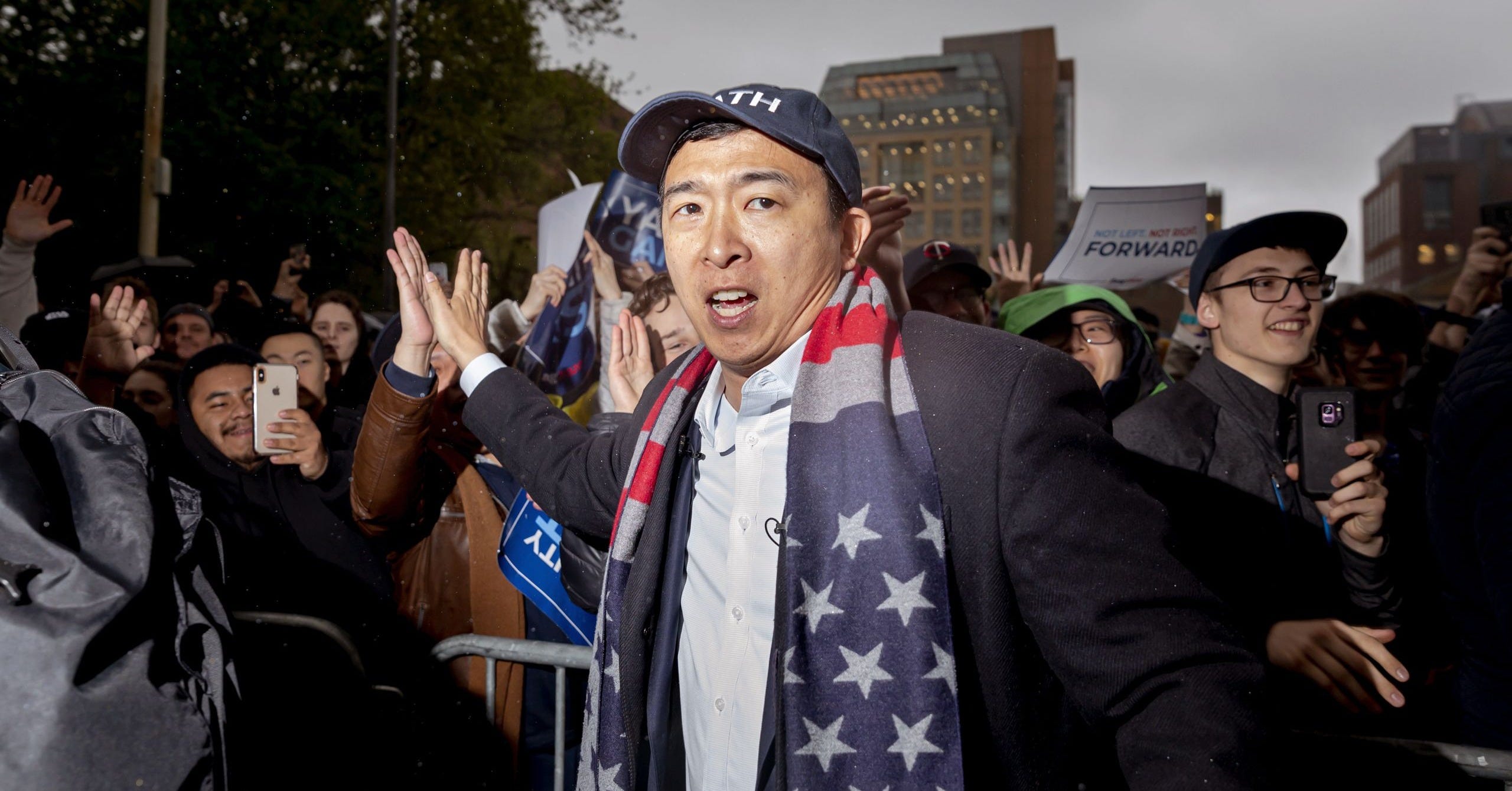
“Ahead of one’s time” is a compliment that many enjoy, but few truly earn. Andrew Yang is a rare case where it’s true.
After years working as a lawyer and entrepreneur, Andrew made his name in the 2020 Democratic Party presidential primaries. Initially viewed as a novelty option, Andrew - with the thrust of his supporters, the ‘Yang Gang’ - quickly became a dark horse pick. Though the candidacy ultimately went to Biden, Andrew bowed out, having changed the perception of what it means to be a Democrat in the modern age.
The next year, in October 2021, he would officially leave the party. Not one to sit idle, later that month, he founded Forward, a centrist alternative to the entrenched two-party system that defines American democracy.
Why did we invite him on?
Though it’s fair to place him to the right of Democrats and to the left of Republicans, to call Andrew a “centrist” would be to miss the point. He’s more accurately understood as a moderate radical: moderate in his outlook, radical in his policies.
His signature is UBI - “universal basic income”, whereby every adult American would receive a wage of $1000 a month. They’d be free to earn more, but that safety net would always be there. Naturally, it was heralded and decried in comparable measure.
But even in 2020, Andrew knew something no one else did: AI was coming.
Six years later, with this burgeoning and mysterious technology taking over more of our workforce by the day, it’s an unavoidable consideration. What happens to all the people put out of work by this new technology? How can its gains be shared fairly? Should they be?
As the man who popularised the principle of UBI in America, Andrew was the ideal person to sit across from and discuss it.
What did we talk about?
”It’s dystopian, but it’s our reality.”
When Andrew brought the subject of UBI to American politics, he was considered a kook, even by his fellow Democrats. Labelled a quasi-communist by his critics at the time, he’s now seen as something of a herald. With the advent of AI, the conversation can no longer be avoided. How did he see it coming?
”I was in Silicon Valley in 2017 after Trump won, at a table of investors and entrepreneurs and inventors. I asked if they were working on AI, and they all said they were. I asked what we were gonna do about it, and it was crickets; if nobody’s going to do something about it, I will.”
Long before we all came to face it, Andrew was sensitive to the side effects of this new technology. More optimistic pundits see where we are as the cusp of a new golden age of the kind that will leave the Industrial Revolution in the dust. Andrew doesn’t see it that way.
”I have no beef with the folks who are working hard to make it happen, but it is going to wipe out millions of white-collar jobs. It is going to supplant the higher-order thinking of an entire generation. It is going to decimate arts, media and cultural jobs; there will soon be AI avatars and writers and actors to create human creatives. Right now, the American economy is based around efficiency, and humans are going to lose that competition in so many contexts.”
The conversation about AI’s effect on the job market so often frames it as a future problem. A near-future problem, perhaps, but nevertheless something we don’t have to face up to just yet. By the time we do, the appropriate arrangements will be made, and the worst consequences will be mitigated.
It turns out, for some sectors of the economy, it’s already too late.
”Entry-level coders and customer service workers are not being hired, and those are just the canaries in the coal mine. Entry-level jobs for college graduates are declining in New York to the point where the unemployment rate for graduates is HIGHER than it is for non-graduates. Right now, there are 2.8 million Americans who work in call centres. How long until AI takes their jobs? To answer that question, you don’t look at a calendar - you can look at your watch. I’ve sat down with CEOs at companies who have told me they’re going to replace 50% of their workers in the next three years, and that if they don’t, their superiors will replace them with someone who will.”
