


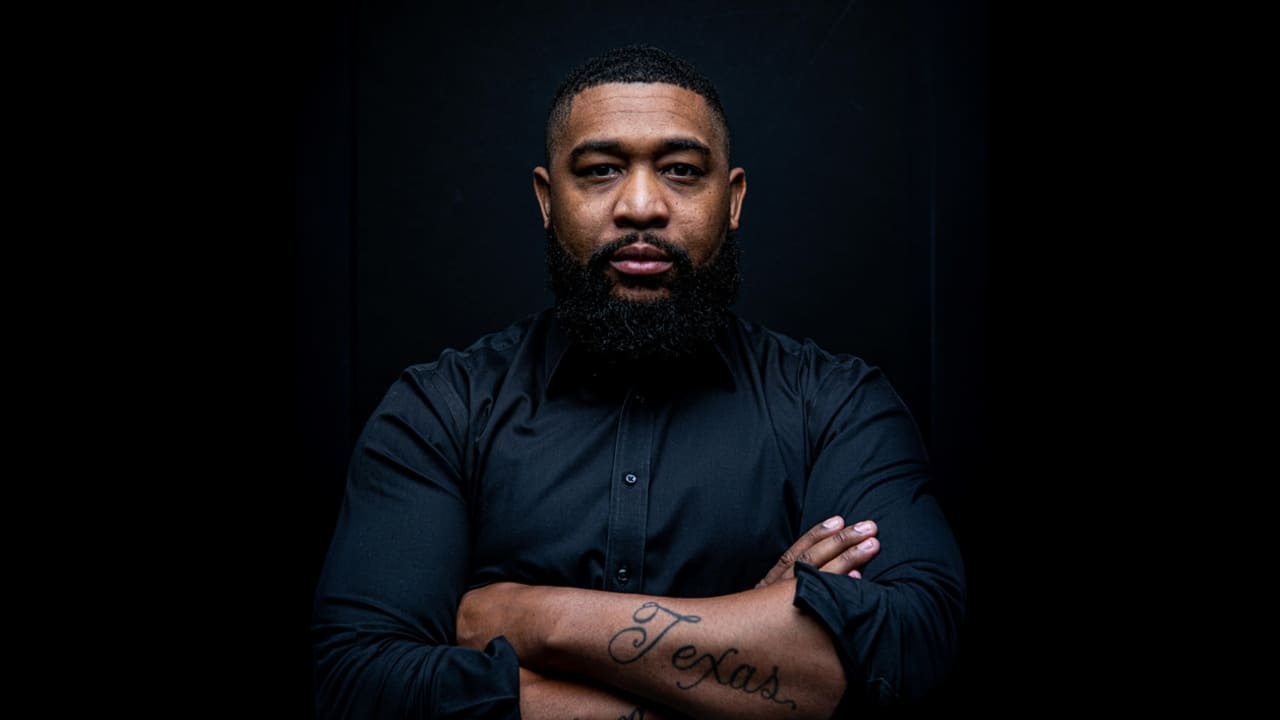
Entering the public eye in just 2017, Brandon Tatum’s rise to fame has been astronomical.
Upon leaving his career in the police, Brandon served as director of urban engagement for Turning Point USA for two years before founding his own media company. For years, he was a close ally of Candace Owens. Together in 2019, they founded BLEXIT, a TPUSA-endorsed foundation that encouraged black Americans to leave the Democratic Party and re-register as Republicans.
In 2021, he released his first book: Beaten Black And Blue: Being A Black Cop in an America Under Siege, and today, his The Office Tatum channel on YouTube boasts over 3.8 million subscribers.
Why we invited him on.
Last year, we had Brandon on to discuss the then-still-raw assassination of his dear friend, Charlie Kirk. In that conversation, he projected what he saw in the American right’s future, and described how he hoped the tragedy could unite his wing of politics.
A year on, quite the opposite has occurred.
The American right is more fractured than it has been since Trump first came down the golden escalator. Perhaps more so. How did that happen? Why?
Brandon is less convinced of the scale of the civil war, but he sees the fissures. He has his own theories as to how they formed, and the forces making them worse. We invited him to share them with us and you.
What we talked about.
”The Republican Party is not as divided as people think it is … A lot of people are still leaning towards Donald Trump and his ideas. Craziness is happening, but it’s mostly aligned.”
Is that true? The thrust of every interview we’ve done on the splintering conservative movement has taken it as a given, whether the guest was part of it or not. Brandon is the first to suggest that, in fact, the party is more united than divided.
But how can that be? If Trump has betrayed so many of his promises, as we are often told, how can all those same people continue to support him? Wouldn’t that lend credence to the cliché that MAGA is a cult?
Brandon explains that, contrary to popular belief, Trump actually kept to his word.
”Everyone says he promised ‘no new wars’. That’s not true; his promise was ‘no new wars… that are unnecessary.’ This is not a never-ending war. I think he has the tactics to get it done and get us out of it. So, I don’t understand why someone who supports Trump would stop now. We can recover, and that’s why I haven’t - and won’t - lose trust in Trump.”
That’s not the only thing Brandon argues is overblown. Another is arguably the motivating factor in American politics today - the affordability crisis.
Millions of Americans are feeling its squeeze. Escalating bills for shrinking apartments, working overtime and skipping meals. For countless young people, the prospects taken for granted in yesteryear - owning a home, starting a family - have been priced into the thin air of pipe dreams.
Brandon calls bullsh*t on the whole thing.
”You go to the airport, and it’s full of people, and I don’t think they’re all travelling on business. Disneyland is full; if you can’t afford to live, why are you at Disneyland? You can’t afford to live in New York, so move! These are choices that people make. When I was a police officer, I made choices that meant I was living paycheck to paycheck. I could have changed that, but I didn’t; I wanted the new car, I wanted the nicer house. I could have sacrificed, and that’s why I was in a bad financial situation. I see that everywhere now - people are not willing to sacrifice, and so they blame the economy.”
To Brandon, it all comes down to decision-making.
”Don’t go to college unless you have a reason to go! If you’re going to be a nurse or a doctor or an engineer then fine, but if not, you’re just burning your experience, money, and time. People who never went to college are now the prime people to hire. I hire people all the time, and I don’t look at your degree; I care about what you’ve done. Have you worked at a place long enough? Have you been consistent? Can you do this job, or do you just know the theory?”
For many people, it’s too late. They were promised a world of riches on the other side of college. Instead, they found their options had dwindled, and saddled with themselves with debt for the pleasure. What are they supposed to do?
