


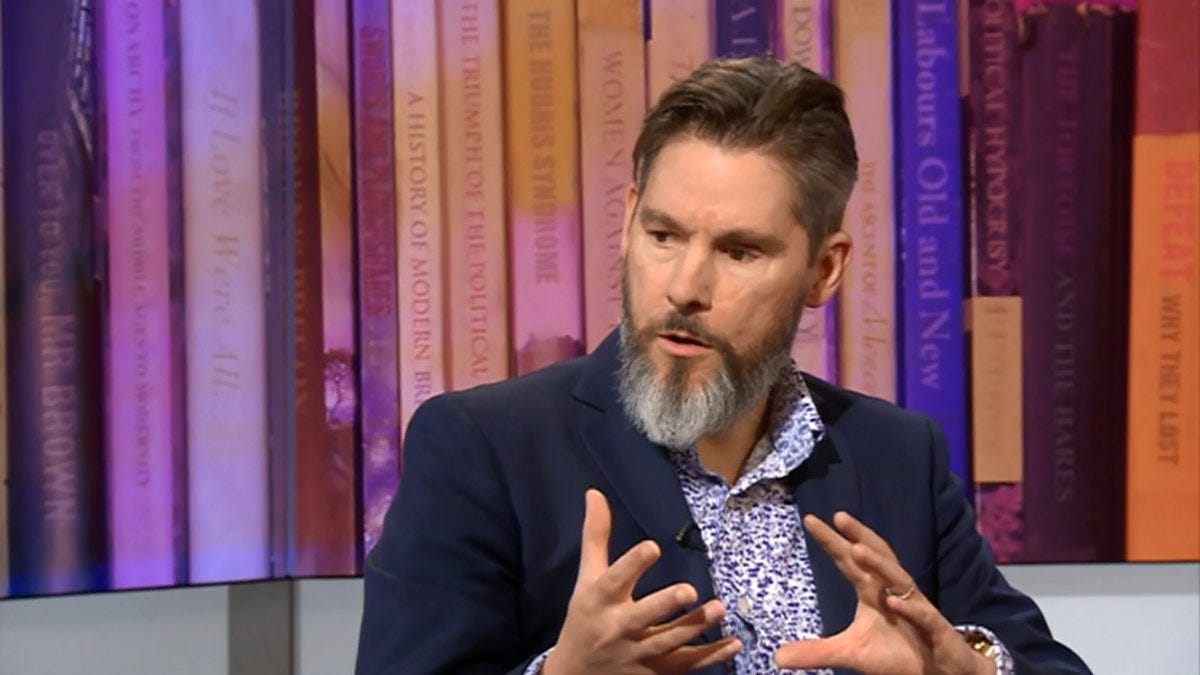
Dan is unafraid to speak out against his ‘tribe.’ As a pundit, he has published work in the New Statesmen, the Daily Telegraph, and for the last ten years, has written a weekly coumn for The Mail on Sunday.
In 2012, while a long-standing member of the Labour Party (whom he has joined and left twice), he voted for Boris Johnson (a Conservative) in the London Mayoral elections, decrying Labour candidate Ken Livingstone as “a disgrace.” The next year, he published a piece in the Daily Telegraph arguing in favour of the censorship of government whistleblowers. Last year, he welcomed immense scrutiny from his peers on the left when he asserted British taxes should not be used for reconstructing Gaza “until every Hamas terrorist is either dead or in jail.”
Say what you will about his positions, we welcome anyone with the temerity to speak out, and have thus been hoping to host Dan for some time.
Now seems like the opportune moment. His former party are enjoying a swell in popularity, its closest rivals are suffering a string of scandals, and British politics looks set to only become more snipey and surprising. Where does he stand on it all?
What did we talk about?
Dan, as we’ve mentioned, has a somewhat tested relationship with Labour. Joining in 1987 at just 18, he left in 2013, only to rejoin (and leave again) two years later. It’s clear he’s no unthinking loyalist. Given that, what does he make of the party in 2026? After Keir Starmer resigned in a sorry state, the least popular PM in living memory, Andy Burnham’s assumption of the role has buoyed support for the once-lambasted party. How does Dan assess the new leader?
”He’s broadly what you see; there’s no hidden side to Andy. People talk about the ‘Northern shtick’, but it’s not a shtick - that’s just who he is. He’s from the North, and it definitely shapes his political outlook … One of the great misconceptions about him is that he wouldn’t be able to control Westminster, and he’d realise it was very different from being Mayor of Greater Manchester. But he’s been in politics all his life; he’s a political creature.”
Some on the left have accused Andy of being a ‘people pleaser’ - trying to curry favour with the left, right, and centre without regard for whether his world view is a coherent one. In the wake of Keir Starmer’s notorious flip-flopping, that’s not what the nation has an appetite for. Is there any truth to the accusation?
”I think he’s preparing for a snap General Election, probably due for some time next year. He’s maximising his appeal between now and then … His job now is to shore up his popularity among the left, see off the Greens, and endure the in-fighting on the right. The real problem is that the fundamentals of the job are no different to what they were under Keir Starmer.”
For as much as we’ve criticised Starmer, anyone can concede he was dealt a rough hand. His technocratic approach, in the new age of populism, was never going to fly. It’s a shift we’re seeing on both sides of the political spectrum, and neither Labour nor Conservative seem to be adjusting appropriately.
This is not a criticism Dan has - evident in his answers is a dislike for the ideology. To him, it’s what makes it so difficult for anyone - not just Andy Burnham - to make the changes that really matter.
”The growth of populism has made it impossible for a politician to make a hard choice without the support of the population. You talk to any MP and they’ll tell you that triple-lock pensions are unsustainable; they’re a hangover from the past. Those MPs know they’re not sound, but if they stand up and say that, they won’t be elected. So, what are they supposed to do? It’s not a question of identifying the problem, or knowing what to do, it’s whether they have a political mandate.”
It puts politicians in a tricky situation. Quite often, the necessary thing is unpopular. For example, Konstantin asserts, cuts in public spending.
Ours is a national in denial. Despite our shrinking piggy bank, we ask more and more of the state, throwing good money after bad in a vain attempt to stimulate - or simulate - real growth. Burnham, so far, promises to be no break in this sad norm.
Dan recognises the problem, but disagrees that tax cuts and spending cuts are the solution. Even if they were, they won’t happen in this political climate.
”You’re never going to win popular support by cutting public spending. We hear it all the time: ‘Things don’t work’. You call an ambulance, and it doesn’t come. You go to a hospital, and you don’t get seen. You get on a train, and it breaks down. I keep hearing from people on the right that the state’s too big. But the people don’t want it shrunk! They don’t want fewer teachers, or nurses, or doctors. ‘We need to stimulate the market’… ask the public if they want the war companies in public or private ownership, and see what they say.”
What people say they want and what they actually want, as we all know, are often two different things. Billionaires may disgust a certain swathe of the votership, but do they really want to live in a country without them? Is it wise for a country in debt to scare off its benefactors?
”I think it’s absolutely imperative that wealthy people are asked to pay a little bit more, in the same way that, in the period of austerity, the working people were asked to pay a little bit more. Wealthy people were broadly insulated from that, and working people were not. I see a lot of right-wingers say ‘but the wealthy pay more’, and I get the point. But the reality is you have to look at what people are paying in proportionate terms. Not just to their income, but the actual experience of their lives. Imagine someone in a working-class community who, for various reasons, can’t afford a house of their own. So they move in with their parents, and their parents have to support them. That has a negative impact on all their lives. If a wealthy person has to sell one of their private jets… It’s just not the same.”
It’s a compelling argument, but in a globalist world where the wealthy can move and work from anywhere in the world, what are we offering them? If we chase them out with high taxes and needless regulation, don’t we ask an absence of growth all together? Perhaps being a billionaire is unfair, but how fair is total financial decline.
It’s a line of thinking that Dan has little time for. In his words, “we tried that, and it didn’t work.”
”If you turn around to the electorate and say: ‘We’re gonna make some hard choices.”We’re gonna cut back on public spending, and you’re going to have to tighten your belts. But we can’t tell the billionaire to do that because, if we do, he’s going to live in Montenegro,’ the British people won’t accept that.”
So what will the British people accept? What do they actually want?
If polls are anything to go by, it might not be Labour - it might be Reform.
