


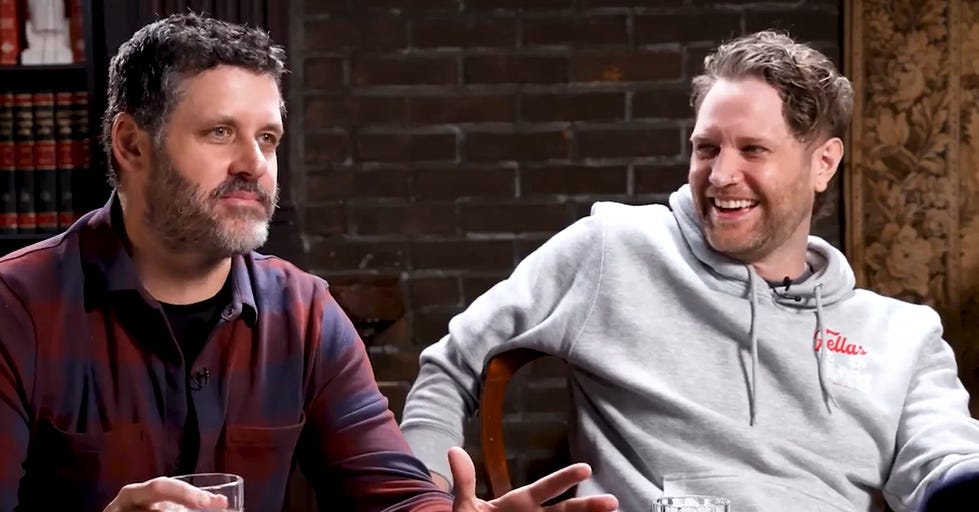
Even at the peak of censorious wokeism, few comedians were able to slalom the lasers of cancellation better than Ryan and Danny.
Together and apart, the two have enjoyed massive success producing viral comic clips for social media, often tackling the hot-button issues of the day. Through these bite-sized sketches, Danny and Ryan have made a career out of mocking political correctness, performative activism, third-wave feminism and the far right. To date, these skits have amassed over a billion views across all platforms.
Since 2020, they have hosted the hugely popular and wildly funny Boyscast, an irreverent podcast focused on all things male.
Why did we invite them on?
Ryan and Danny are two of the most popular comedians of the internet age, and understandably so. At the height of self-censoring in comedy, they remained unbowedly true to themselves, maintaining the irreverent spirit that makes the artform so special.
We hosted Ryan on our show in 2021 and the following year, we both appeared as guests on the Boyscast. It was a hilarious conversation, and we felt it was high time we returned the favour.
What did we talk about?
Comedy has always adapted to the medium and events of its day. In the advent of the internet, it has never had to move so quickly. It’s no longer enough for a comic to just be funny. They’ve got to produce clips, host podcasts, film all their sets, craft sketches, and work as full-time social media managers. Ryan and Danny have flourished in that environment, but they recognise there’s been a cost to the artform.
Danny: “I’ve been at shows where the host sets up a camera and does crowd work. Just the basic stuff… ‘What do you do?’, asks everybody. And the next comedian sets up their camera and goes up and asks the same question! Is that what comedy is now? Just asking the audience what they do? I was at a show once, and the heckler went up to the comedian after and asked if he’d filmed it. The heckler wanted a clip of him heckling the comedian for his own thing! It’s really next level…”
In the last few years, comedy has infiltrated everything. Trash talk has become the standard patter between pundits and political debates have become roast battles. Even
CNN host Jake Tapper’s set has been remodelled to resemble the stereotypical podcast studio - even his mic is placed on a desk littered with bobbleheads.
”That’s where he’s filming his multimillion-dollar show! If we had his budget, we’d be going for the classic news set.”
Ryan: “Now he’s trying to look like a sportscaster.”
It’s all symptomatic of the long forecast, inevitable heat-death of late-night TV.
For decades, late-night TV was the fortress of entertainment. If you could make it onto the other side of those walls, you were set for life. These hosts had the power to anoint aspiring celebrities with careers beyond their wildest dreams.
Now, that all sounds absurd. What happened?
There’s never any single factor in these downward spirals. But undeniably, the politicisation of these shows played a significant role. Americans would tune in to Fallon, Colbert and Kimmel to escape the heady and divisive reality of politics. Soon, they had no place to turn. The institution was never the same again.
Danny: ”Colbert dancing around and singing about the vaccine… And that was with a team of thirty writers. There are thirty people who make full-time salaries working for that show, and they all passed that.”
Ryan: ”It’s like seeing the girl in the morning without the make-up on … Actors are the same. You see them now doing a video with an influencer, and you go ‘Wait, this guy can’t act! He just had explosions behind him.’”
A select few hosts have had to bow out, but many of the main players have stuck around. Can it last? How long does, say, Colbert have left?
Danny checks his watch:
”About a month.”
It’s a strain to mourn this ‘loss’.
Then again, what do we have instead?
The evaporated trust in institutional media is no bad thing, but humans don’t do well with uncertainty. Instead, people are clinging to any wild theories they hear. The wilder the better - namely, conspiracy theories.
There’s no denying it - conspiracies are a lot of fun. The trouble comes when they tip over from low-stakes fantasy to unsavoury suspicion…
