


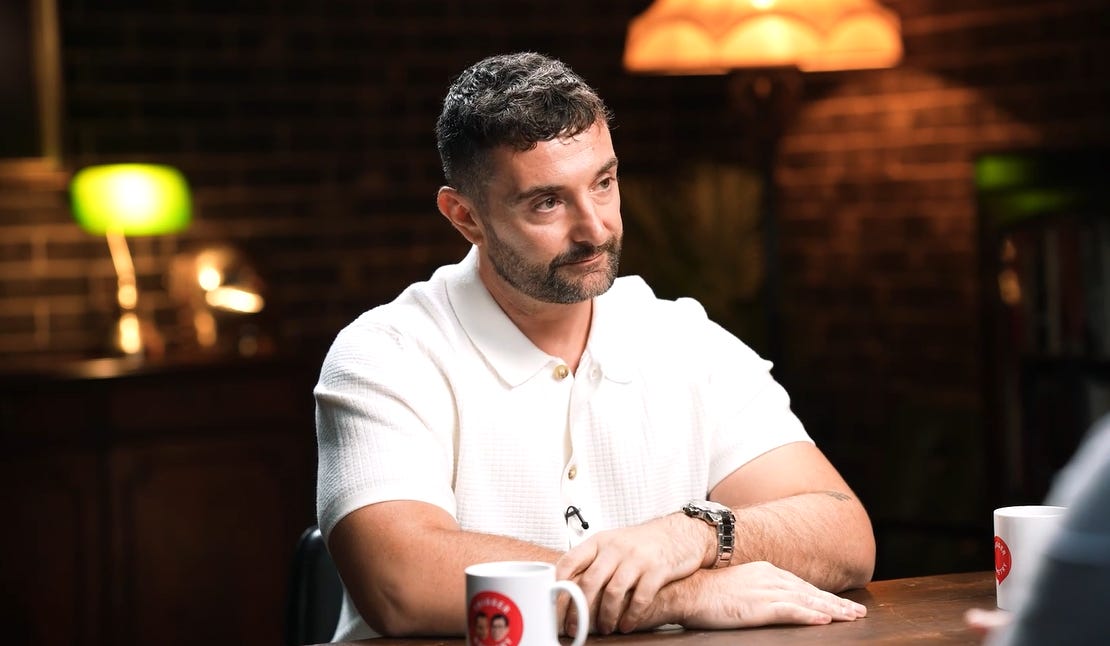
You won’t know Dimitar by name, but you’ll want to know his story.
A former MET officer, Dimitar is joining us to speak publicly for the first time about his experience on the force, their DEI practices, and the recruitment procedures that are weakening our institutions of law.
What is the state of our police? What does it entail for society? What does Britain’s future look like if things don’t change?
What did we learn?
Talk to any Londoner who doesn’t live in a sequestered, guarded alcove, and they’ll tell you the same thing: the city has become noticeably more dangerous. Everyone has either seen or been, or knows, the victim of a mugging. Petty theft is normalised, knife crime is a fact of life.
Then again, rose-tinted glasses are a powerful lens; perhaps London, as many capital cities are, was always a more threatening part of the country. Are they right to think things are getting worse?
“Yes. That’s more definitely the case. I actually think people don’t speak enough about how dangerous London has become; they have reached a level of detachment from reality. They’re bringing it up, and nothing really happens. A lot of people know, but they don’t talk about it anymore.”
But isn’t crime going down? The government love to brag about how the trend for crime, especially violent crime, is on a downward trend. The statistics certainly seem to bear that out.
”The statistics are saying that because people aren’t bothering to report it. Let me give you an example. I don’t have many hobbies, but I love mountain biking, so I bought an expensive one. After a couple of months, it was stolen. I, a police officer, didn’t report it, because I knew nothing was going to happen.”
So, what else are they doing? By the sounds of it, not a great deal of policing.
One of the things we wanted to discuss with Dimitar was the nature of police training. Neither of us - it’ll surprise you to hear - has a moment of experience in it, but much has been made about how ‘wokified’ it has been in recent years. Is that true?
”In the training, we had a lecture called ‘How Treating Everyone Equally Leads to Inequality’. It’s a little Orwellian … We didn’t want to learn like that. We wanted to be on the street learning practical skills, and my class was outspoken. But we were told if we didn’t do it, we could lose our jobs.”
Dimitar and his peers were given an option - absorb the nonsense (that even the teachers realised was nonsense), or leave policing entirely. What they learned was not just benign; it had serious consequences on the psyche of officers. Dimitar felt it first-hand.
”You start to doubt yourself. ‘Am I right to say All Lives Matter?’ It’s a perfectly reasonable thing to say, but am I right? ‘Maybe I’m wrong, maybe I need to find within myself that I have a bias.’ It makes young officers question themselves.”
