


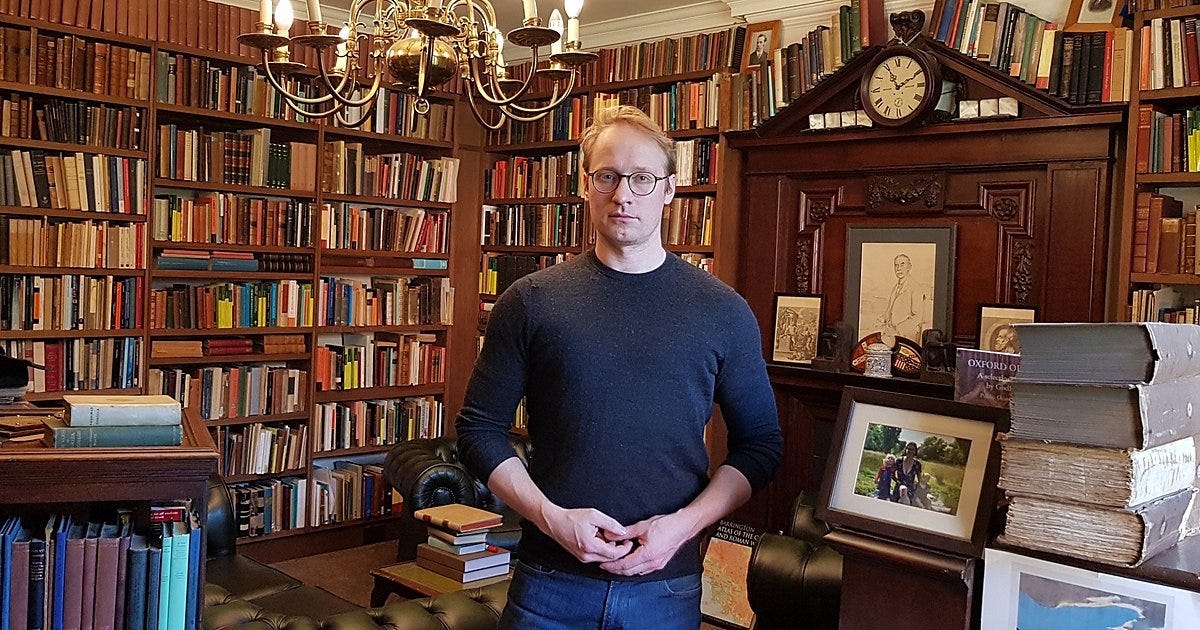
Dr David Butterfield has one of the most enviable academic resumes one can imagine.
His journey began as a student at the University of Cambridge, where he would remain for two decades as a Senior Lecturer in the Faculty of Classics. During this time, he was also a Fellow of Christ’s College and Queens College, working as a Director Of Studies at the latter. Today, he is the Provost of Ralston College, as well as a Professor of Latin, a private college in Georgia dedicated "freedom of thought and speech". Elsewhere, David is also literary editor for The Critic, senior fellow at the Pharos Foundation, and the editor-in-chief of classics journal Antigone.
Why did we invite him on?
We met David in Greece on a Ralston-associated tour. There, we had an absolutely electrifying conversation about the nation’s ancient history, as well as the Roman Empire, and how these two epochs laid the groundwork for modern society as we see it. We bombarded him with questions and queries for hours, and could have carried on for hours more.
We decided to do exactly that. This time, however, we’re sharing it with you.
What did we talk about?
This is one of the most all-encompassing subjects we could ever hope to explore on our show. The story of Greece is one of politics, science, philosophy, art, language, and ethics. Before we go any further, we need to answer the most fundamental of all questions: what is civilisation?
”It’s a controversial question, but I think unduly … The best we can do is point to certain things that are needed for a civilisation and see how far that takes us. A group of people need to have stability. Geographical stability, an agricultural and economic base that allows them to be rooted in one place. They also need political and social stability - a fixed law code, an established hierarchy, a military to defend them from encroachments. But there’s also more than that…”
What David says next is the most profound of his insights on this question. All these other attributes, while necessary, are insufficient for what we might call a ‘civilisation’. The crucial detail is immaterial - it’s something that exists only in the minds of the members.
”Civilisations have self-awareness. A shared consciousness of the civilisation of that group of people. That requires a willingness to commemorate and memorialise those who came before them. Something that carries across time and space.”
This guides us beautifully to the topic we wanted to explore - Ancient Greece, and how it acted as a cradle for Western civilisation.
’Western civilisation’ is, nowadays, a controversial term. We use it all the time, but certain academics, journalists and public thinkers bristle at its notions. They suspect those who use it have some underhanded, nefarious reason for doing so. Is it a dog whistle? Does it even mean anything?
To David, these questions are absurd.
”If you read modern books, modern op-eds, criticising the term ‘Western civilisation’, the arguments are childish counter-claims. ‘How can it be ‘the West’ if some of the countries in it are in the East?’, ‘How can it be truly Western if some countries in the West don’t have these features?’ This is not meaningful to understanding the world we’re in. Fundamentally, the West would look nothing like it does - and there’s no way we would be having this conversation - without the intertwined the Greco-Roman intellectual and artistic traditions, and the thread of Christianity. That’s indisputable fact.”
So what is the Greco-Roman tradition? How is it different to what other people believed at the time, or even still today?
David is quick to stress that, despite the contraction, these two empires were not equally influential.
”Rome is extremely important, and also not important.”
How so?
”Most of the Greek ideas that matter, that survive and are catalysed in Western society, they are refined by Roman conquest of Greece. Without the Romans, it’s an open question of what the fate of the Greeks and the West would have been. But if we had a weighing scale with the intellectual contributions of the Greeks on one end, and those of the Romans on the other, the scale would break in favour of the Greeks.”
Put simply, the Greeks gave shape to modernity. In our age of industry, mechanics, automation and convenience, we remain students of a society built with marble and stone. Logic tells us that, because we observe progress in our lifetimes, one could theoretically trace that back and find a coherent lineage to the dawn of man. A line that can be drawn to the earliest known societies.
This, David suggests, is a falsehood. Ancient Greece wasn’t a continuation of anything, but a self-actualising shift in human thought.
”We presume that people have always been asking the big questions. That’s not the case. There are intellectual turns that happen in Greece, in centuries B.C., that as far as we can tell are entirely new [to them].”
To illustrate his point, David tells the story of Thales Of Miletus, a pro-Socratic philosopher and one of the ‘Seven Sages’ - a founding figure of his time. To many historians and anthropologists, this single figure is something of a forefather for science itself.
”He begins to ask scientific questions, cosmological questions, questions that break from seeing the world as a result of divine command. He is able to use astronomical knowledge and mathematical ability to predict a solar eclipse. That day is, in some circles, seen as the day science ‘began’. Not because a calculation of that kind could be made, but it showed there were rational principles underpinning these cosmic events that hitherto had been seen as divine.”
The basic principles of research, of attempts made to understand our university, were born here. It’s hard to think of a more profound change in the human psyche than that. The very notion that we can track it is itself baffling.
Yet, this only accounts for half of the story, and arguably less than that. Just as influential as the advent of science is the Greeks’ modernising of artistic expression - the birth of ‘art’ as we know it.
”There is no genre of artistic production which isn’t live and thriving in Classical Greece. They didn’t inherit that from other parts of the world - they invented them. Tragedy, drama, comedy… It’s unparalleled, both in its innovation and its enduring legacy.”
Still, these unthinkable leaps may be overshadowed by Greece’s political contribution…
