


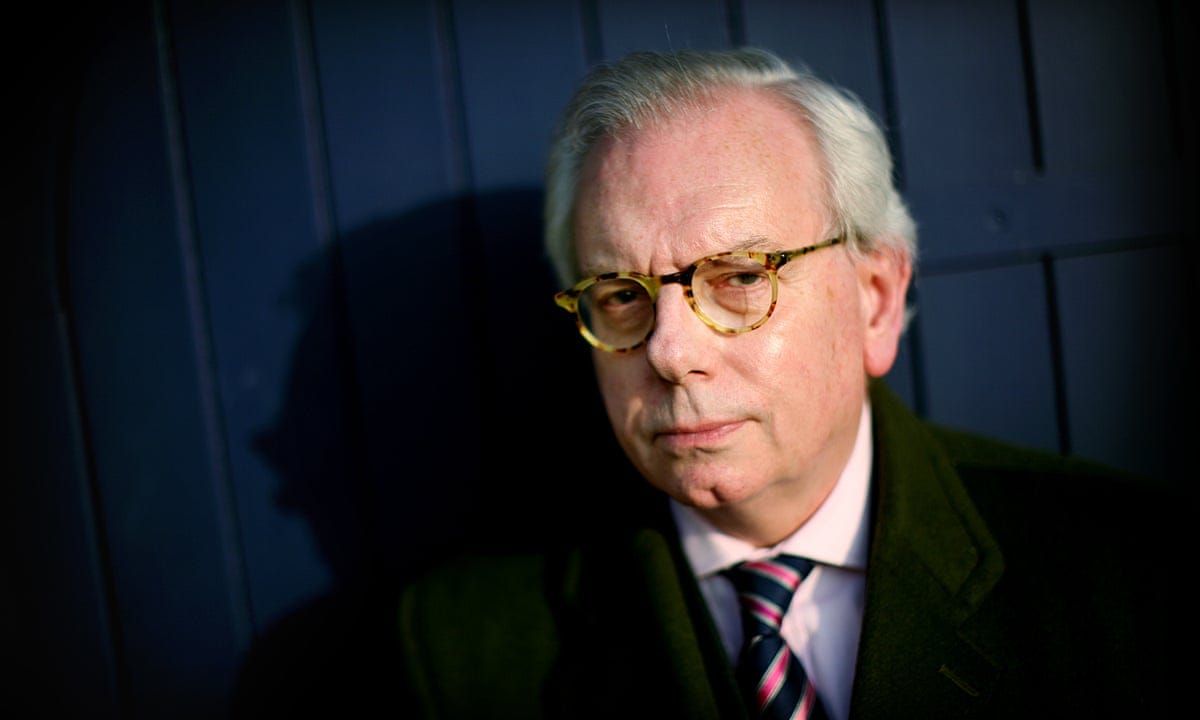
Like him or loathe him, there’s only one David Starkey.
After decades of exemplary work as a historian and a lecturer at Cambridge, David truly entered the public conscience during his time contributing to the BBC Radio 4 debate programme The Moral Maze, a tenure that earned him the title of the “rudest man in Britain” from the Daily Mail. Sinc then, he has become something of an unorthodox national treasure, inviting scorn and applause in comparable measure.
Today, David runs his own YouTube channel, David Starkey Talks, where you can find him discussing British history, contemporary politics, and academic freedom.
Why did we invite him on?
Our country is undergoing a seismic political shift. As populism continues to rise, the two core parties crumble in public esteem. Who will harness the movement and take office next remains to be seen. By tomorrow, we might have some idea.
At the time of writing, the citizens of Makerfield are selecting their new MP. A constituency in Greater Manchester, one might be forgiven for not recognising the gravity of the result. But what comes of it may prove to be hugely consequential for Britain’s future.
David is one of our favourite recurring guests. He’s made four appearances on our show, and each has been more entertaining than the last. We always look forward to having him back, but recent developments in British politics made it essential.
Labour. Reform. Restore. Who does David back? Who does he think will win? Depending on who Makerfield choose, what’s in store for the United Kingdom?
This is your place to find out.
What did we talk about?
Before we get into the fine detail, we ought to get a bird’s eye view, and identify what vantage point we’re looking at the future from. David describes himself as a conservative. Still, he’s had no shortage of criticisms for the party and its leadership. Later in the interview, David informs us - in no uncertain terms - that, given the chance, he would shoot Theresa May.
“I remain a nominal member of the Conservative Party, but I am friendly with everybody on the right.”
Though he is ‘friendly’, David never bites his tongue. He has cutting things to say about everyone from the new darlings to the old guard. A figure in ascent today is Rupert Lowe. Once a key character in Reform UK, he now attacks his former party from the right, making himself one of the most controversial politicians in Britain today. What does David think?
”Rupert is the bizarrest of things. He’s presenting himself as the ultimate outsider, aligned with all these young men online. Charlie Downes, Conor Tomlinson, all the young toughies on the right, the ‘Lowe-mosexuals’. But he’s a farmer! He shoots pheasants, yet he presents himself as an extraordinary outsider. These are increasingly ridiculous postures!”
Rupert’s rise is, at least in part, a response to Conservative failure. Big C, that is.
After enjoying 14 years in charge, the Tories are a shambles. With each passing election, they lose power and, in turn, relevancy. The once-unshakeable institution has pinned its hopes on its latest leader - Kemi Badenoch. Despite the party’s downward spiral, Kemi seems to be one of its more popular MPs. Does she give David hope?
”She’s very impressive, but until there’s a full-scale mea culpa, until the Conservatives admit what went wrong, they don’t have a chance. I can only imagine the reason she hasn’t is that she fears half the party will join the Lib Dems. She suggests that the reason the Conservatives failed is because she wasn’t in charge, but really, it’s because they followed the wrong policies as established by the Labour party.”
Throw Reform into the mix and what we see is a divided right. Conservatives who are conservative in name only, rebel upstarts Reform drafting in its members from the failed party that inspired its founding in the first place, and Restore, a radical outpost of cryptic identitarianism.
To David, that’s an accurate reading. But one that misses the bigger picture.
”There are two forces moving in two completely different directions. On the level of personalities, these are increasingly radical positions. It’s Hobbesian - a war of all against all. Restore is yapping at the heels of Reform and Reform continue to denounce the Tories. You’d think they weren’t fighting Andy Burnham; they’re just fighting each other.”
On the surface, the right is fractured and irreparable. As the leaders scramble for dominance, they resort to sniping one another, calling into question their right-wing credentials, desperate for the voting public to see their rival as the real loon.
Yet, quietly, on the level that matters, the right is coming back together.
”On the level of policy, everybody is moving towards each other. This, for me, is the important thing. My view is that there has to be a reunion of the right, and the only basis for it is policy. All three parties of the right realise that they’re not dealing with something fractured. They’re dealing with a single central issue: the system has failed.”
When the system fails, opportunity emerges. Opportunity for radicals. Pundits, politicians and organisers who vow to raze the ground and start again. We’re saying it on both sides. Just as Restore promises to reconfigure Britain into the image of yesterday, the Greens have ambitions of rebuilding society from scratch. To David, it’s no surprise - doing nothing is no safer than starting again.
”If you look at the alternative - the nation continuing down the route it’s going - it is a catastrophe. A vicious downward cycle. There is no way you can break it without fundamental changes.”
What are the fundamental changes? What is so wrong with Britain that it needs to be altered on that granular level?
”The British state has stopped working. It has an autoimmune disease. The machine is eating itself. The system has failed.”
Coming from David Starkey, it’s a chilling recognition. A man who has always exhibited immense national pride, as well as a derision for revolutionary thinking, now has no choice but to call it for what it is - a failure of the institutions.
But if that’s the case, and if radical solutions are needed, what makes him think the right is so much more credible to handle it than the left? If we have to start again, why not start again in their vision?
Because the left doesn’t even know it’s happening.
”The right is slowly beginning to recognise that, so there is some hope. The left is blind to this. What on earth is ‘Burnhamism?’ It’s just re-heated Reevesism, which is just a reheating of Bidenomics. We have Bidenomics without the bucks.”
Again, looking at the prediction markets on the day of the by-election, Burnham has pulled ahead as the favourite. Reform’s Robert Kenyon and Restore’s Rebecca Shepherd have taken a hit, and Labour’s candidate looks set to leave with victory.
If he does, he might take Keir Starmer’s job from him. Should that happen, a Labour victory in 2029 is not out of the question.
If that happens, if the status quo remains the status quo, what does that mean? How serious is the problem?
