


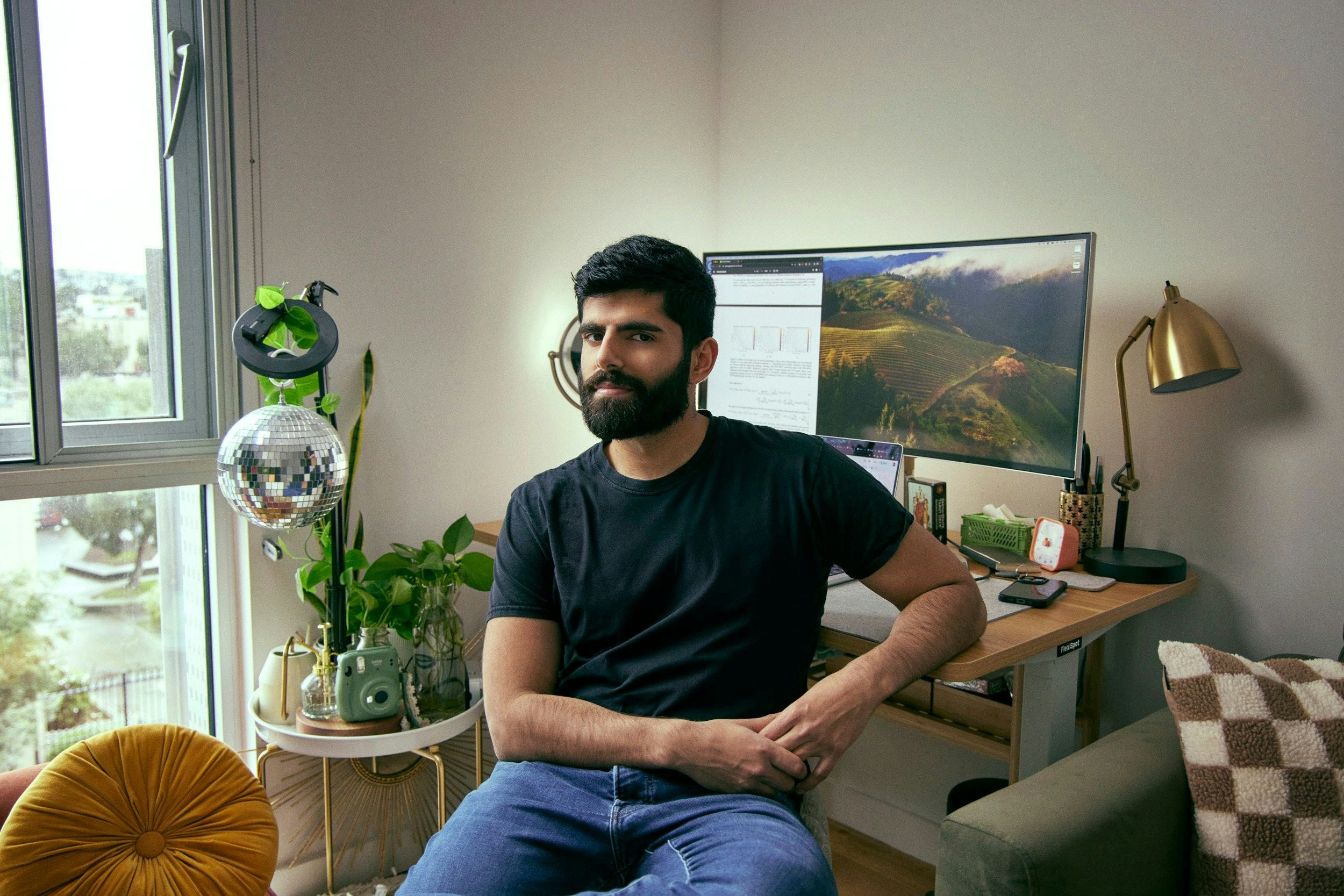
“Silicon Valley’s favourite podcaster.”
It’s a hell of a title, currently held by Dwarkesh Patel.
Specialising in interviewing influential, divisive figures from science, technology, politics and history, Dwarkesh Podcast has become one of the most acclaimed shows of the decade. Through it, Dwarkesh established himself as a leading commentator on the subject of AI, even earning a spot in Time’s list last year as one of the 100 most influential people in the field.
Last year, he, alongside co-author Gavin Leech, published his first book - The Scaling Era: The Oral History of A.I, 2019 - 2025.
Why did we invite him on?
On this topic, we’ve had conversations with figures who hold all manner of views. Evangelicals who herald its arrival as some kind of second coming, doomsday thinkers who see us rolling out the red carpet for our own demise, and everyone in between.
Dwarkesh has spent as much time exploring the topic in public as anyone of his discipline, so we were curious to see what he’s made of the arguments so far. Has he become more or less optimistic over time? How does he see this paradigm-shift development playing out for us?
What did we learn?
”Among Silicon Valley types, I’m seen as a sceptic. They think the singularity [AI systems that can do anything humans can] will happen yesterday, I think it’ll take 5-10 years … The models are not amazing at discovery. They don’t ask good questions. Humans are great at idiosyncracies - exploring weird angles that nobody else is thinking about. AI is basically an average…
But even I’ve had to admit the progress has been fast.”
This is a subject where the messenger’s role matters acutely. Hearing about the brilliance and reach of AI from someone who manufactures it - and therefore stands to capitalise on others believing in it - is one thing, but from a sceptic? That’s something else entirely.
But even AI’s critics agree with Dwarkesh - we are hurtling towards unprecedented change and, once we pass a certain threshold, there’s no going back. What happens then, nobody can know for sure.
Dwarkesh has spoken to virtually every eminent figure in this world. What is it they want?
”Maybe 40% of the population is doing work that a computer could do. Take an AI, put it on Zoom, give it a Gmail account, and it could do their job. AI companies want to be able to do all of that work, and they think they can get there in a year.”
Is that a reasonable aspiration? Or, more importantly, a desirable one?
When you look at the the handywork of AI as it exists today, that might sound absurd. Take a read of any writing - articles, books, papers, whatever you choose - that has been found (or even accused) of being written, even in part, by a language model.
You can always tell. Addled with cliché, riddled with mistakes, and lacking in invention. An AI might be able to write a perfunctory manual, but it can’t produce truly great work.
However, that’s only true today. Tomorrow is another story. The rate of improvement these models are undergoing is exponential, and the threshold is screeching into view.
”It’s reaching a point where it’s more useful to hire AI. For me to get what the AI does, but from people, I’d have to hire several analysts. It could cost me seven figures a year.”
Expecting corporations to ignore those kind of incentives is a big ask. But if they can already save millions a year by firing their analysts, why haven’t they?
The truth is, these models are not yet reliable. Before our America trip, Francis asked Grok to suggest guests who hadn’t been on the show before and would be a good fit. Its first answer? Douglas Murray, who - we don’t need to tell you - has indeed been on before.
If a human has to fact-check the AI’s work anyway, of what use is the AI? Doesn’t the need for people in that role itself undermine the supposed ‘power’ of this technology?
”AI, like people, has thought patterns - it’ll spin off and get confused. Grok will have scanned the Internet and seen ‘Douglas Murray’ and ‘Triggernometry’ next to each other, and [rightly] believed there was some kind of relationship there. It’ll get better at that.”
Last month, Dr Roman Yampolskiy - the forefather of ‘AI safety’ - warned us that we as a species are massively underestimated the risks associated with AI, specifically AGI. He believes, with 99% certainty, the advent of AGI will result in the extinction of the human race.
That may be so. But do we also underestimate the potential benefits?
Konstantin relays a story of a recent trip to the dentist. His was already using AI to measure gum recession, scan for decay, approximate the-
”Let’s just replace the dentist!”, Dwakresh reacts, “Why should I stand in line for three hours just to be told ‘You’re fine, go home?’ If I have the doctor on my phone, and I can talk to it, and can get the check-up there and then, I’ve saved a lot of time and a lot of money.”
Dwarkesh recommends that if someone is nervous about looking forward, they should look backward instead. What they conclude about the past might tell them how to feel about the future.
”There is no amount of money you could pay me to go back and live in the year 1000. There’s no way of me having the same quality of life there - the goods simply do not exist, no matter how much money I have.”
The ‘architects of AI’ have been inescapable, appearing on every podcast and chat show to communicate the marvellousness of their technology. Yet, on every occasion, they seem to say something that makes the public bristle. If this is going to a thrilling world of unprecedent prosperity, why have they been so bad at communicating that?
As Dwarkesh explains, they don’t know. Not because they haven’t thought about it, but because they can’t know. The change that’s about to happen is so pervasive and profound, even those leading it are behind the curve.
”If you were alive in the 14th century, surrounded by people dying of the Black Death, it would just seem normal to you. You wouldn’t see it as something that needs to be ‘solved’. We’re in a similar position now. We’re like the last people before the Industrial Revolution. ‘What are the benefits of the Industrial Revolution?’ We can’t really know until it happens.”
Even comparing this to the Industrial Revolution feels insufficient. Contrasting what happened post-industrialisation and what may be possible in the wake of AGI, factories and power plants seem quaint.
We’ve already explored the disappearance of ‘knowledge work’ and the challenges associated with physical work, but what about the most human pursuit of all?
Art.
