


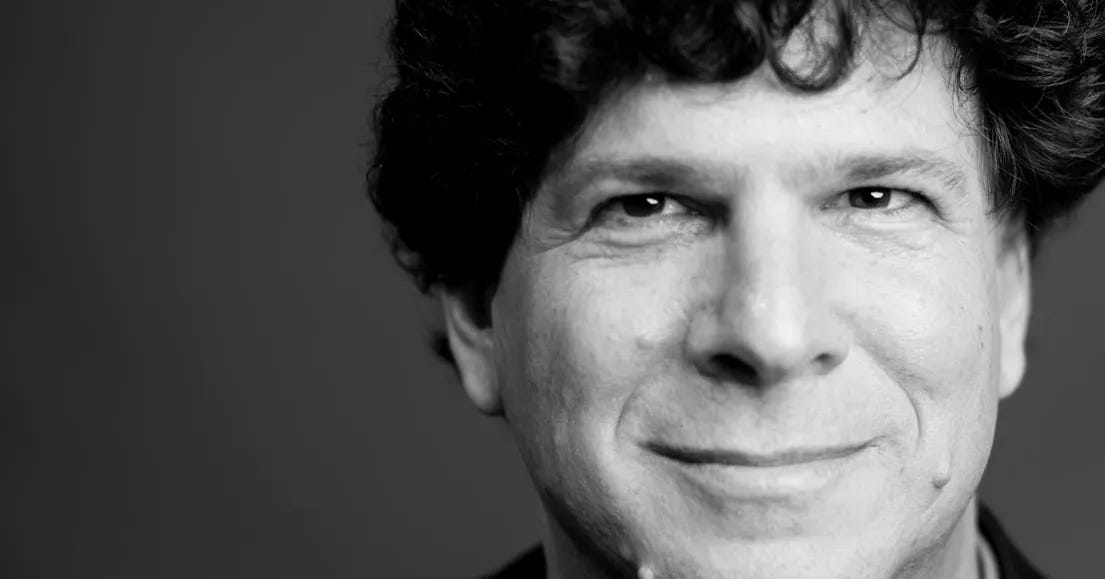
Financier, physicist, social critic and podcaster. Eric Weinstein is a modern polymath.
Establishing his public figuredom as managing director of Thiel Capital, he later became widely recognised as a key member of the ‘Intellectual dark web’ - a loose group of academics and commentators who came out in opposition to political correctness and left-wing identity politics. Today, he continues to host his popular podcast The Portal and researches potential extraterrestrial life as a member of The Galileo Project.
Why did we invite him on?
This episode marks Eric’s fourth appearance on our show. So far, we’ve explored A.I., Israel-Palestine (in a viral exchange with Sam Harris), and Trump’s return to politics. This time, we wanted to focus on another of Eric’s areas of expertise: physics.
Nuclear war.
It’s a conversation we’ve had with Eric several times behind the scenes, and we felt it was time to put it before the lens. In stiff competition, it makes for our weightiest yet.
What did we learn?
”The harnessing of nuclear energy is much more important than the birth of Christ. Before that, we didn’t have the power of God. Then, we did.”
Nuclear power, for better or worse, might be the single most staggering achievement in the history of mankind. And that might still be understating it. For something of that magnitude to have arrived in the last century and go so widely undiscussed is baffling. To Eric, it’s a mistake we make at our peril.
”We fictionalise these weapons so we can continue to live our lives … We’ve forgotten the power. It’s astounding. We used to tell stories about it - Dr. Strangelove, On The Beach… but we stopped. We no longer think of it as an immediate threat.”
Paradoxically, nuclear bombs have a remarkable utility in peacekeeping. When the superpowers can destroy one another and themselves at the press of a button, they’re likely to think twice about coming to blows. The cost of war has become unpayable, and war has (in turn) become less present. Shouldn’t we take comfort in that?
”It’s worked for 80 years… If you’re happy with that, then fine. But it’s a drop in the bucket when it comes to geological human time. In the short run, they make the world a lot safer. They are, by that standard, the most wonderful thing that has ever happened to humanity…”
But why would that change? Even with a small sample of years, the principle shouldn’t change. In fact, as nuclear weapons become more sophisticated and more devastating, the cost of conflict will only increase. Won’t that make war less likely?
”Only if everyone remains rational. The threat of armaggedon keeps the peace. But men who have never gone to war tend to talk tough, because they have no idea what they’re talking about. The guy who’s actually seen stuff tends to keep quiet. And we have too many people in a masculinity crisis at the head of world governments. Several times it’s come down to sheer good luck, and I don’t feel like playing Russian-American roulette forever. There will never be a peace dividend as long as we know how to create this technology.”
Eric’s comments naturally bring us to the most precarious war situation of our time: Russia-Ukraine.
One of the most peculiar shifts in American politics this decade is the increasing right-wing sympathy for Putin, and the idea that Ukraine - and by extension the West - was ‘asking for it’.
Eric doesn’t agree. He sees the invasion as nothing short of an abomination. Which is why his proposed solution is so surprising…
