


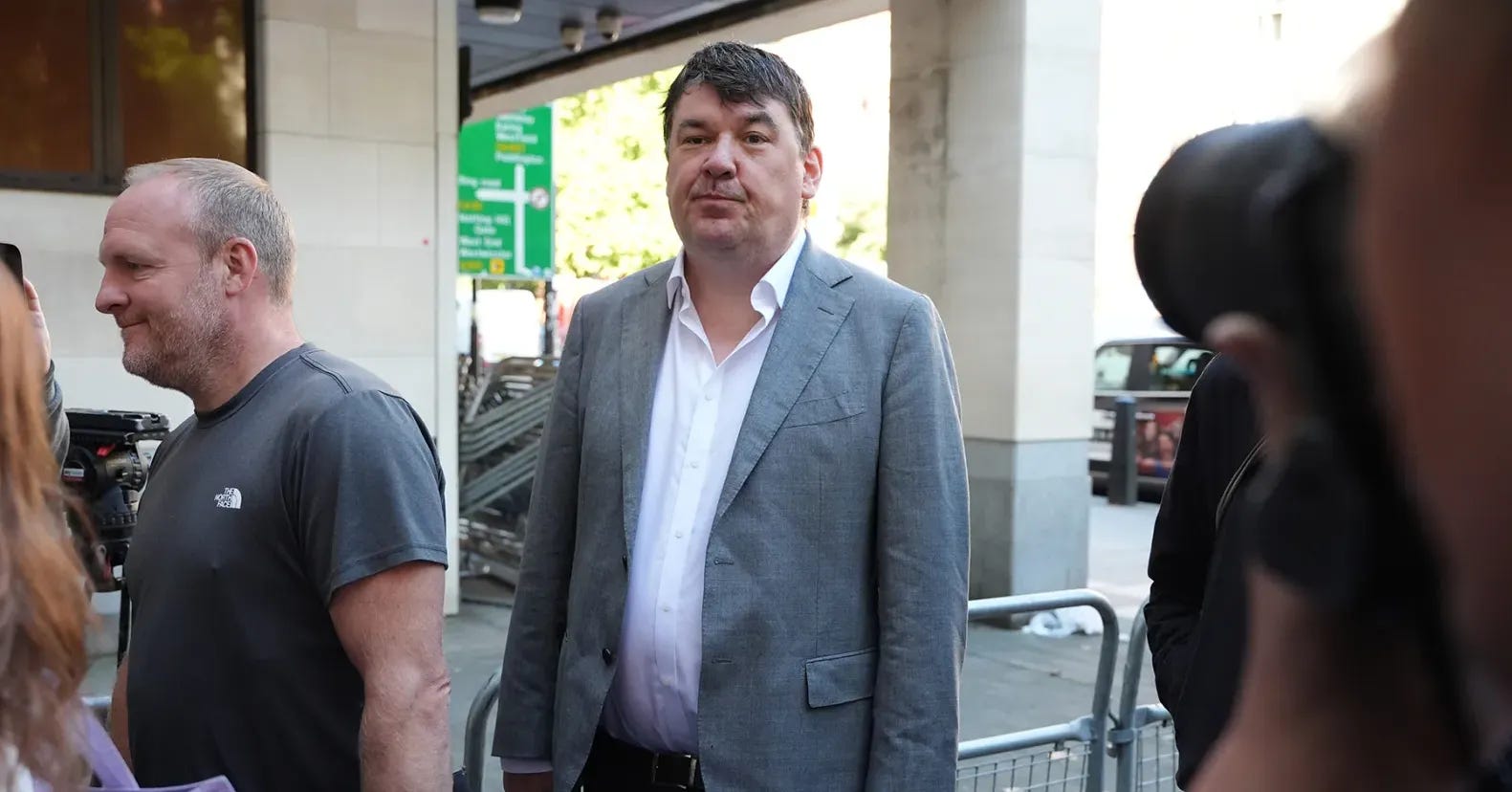
There may be no living figure who has made more of a mark on the last 30 years of British comedy than Graham Linehan. Across his career, he has created/co-created three of the most highly regarded sitcoms in the history of the medium in Father Ted, Black Books, and The IT Crowd, and helped shape contemporary satire through his contributions to The Day Today and Brass Eye. More recently, he has entered the field of stand-up comedy. Famously, during the Edinburgh Fringe of 2023, the venue he was due to perform at axed his set - he instead performed on the steps of the Scottish parliament. Today, he is working on an as-yet-unannounced film with American comedy legend and Trig guest favourite Rob Schneider.
Why did we invite him on?
Graham was, until very recently, the most celebrated comedy writer of his generation. He was Ireland’s John Swartzwelder - everything he penned secured critical acclaim, awards (8 BAFTAs) and a cult following. If Graham had a new sitcom, everyone in the industry paid attention.
In 2018, everything changed.
Graham began to speak out against the rising phenom of trans ideology, and one by one, everyone in the industry turned on him. Work dried up, colleagues ostracised him, and his sure-to-be-hit musical - a long-awaited finale to his magnum opus Father Ted - was shelved indefinitely.
In 2023, he detailed the story in his memoir, Tough Crowd: How I Made And Lost A Career In Comedy, and we invited him on to share it with our audience. Graham was visibly rattled by his experience. In our interview, he described having to hide his car, for fear of it being repossessed. For a time, Graham’s story seemed to be one that ended in defeat.
His activism, in his words, cost him his career and his marriage. But Graham never bowed; he showed remarkable courage in the face of extraordinary circumstances.
Since then, however, the conversation around trans has utterly shifted. Between the Supreme Court ruling on the definition of ‘woman’ back in April and the Cass Report and the Olympic boxer fiasco, more and more people started to speak up. Graham was vindicated.
In September, he was arrested.
What happened? What did Graham say?
And more importantly, what message were the authorities trying to send?
We wanted to know, and there’s no better way than speaking to the man himself.
What did we learn?
”I didn’t get angry until they told me I was under arrest. Then I got really angry.”
As Graham stepped off his flight from Arizona, he was greeted by no less than 5 armed officers. They informed him that he was to be placed in police custody on suspicion of inciting violence. In a free country, armed officers are typically not sent to detain middle-aged comedy writers with no previous offences. He must have done something very serious.
”Three tweets. Fairly standard, angry tweets about the insanity of the situation. Men being able to enter womens’ spaces without challenge.”
What did he actually say? Did he share the address of a trans activist? Draw up a hitlist? Publish plans to bomb the Tavistock?
”If a trans-identified male is in a female-only space, he is committing a violent, abusive act. Make a scene, call the cops and if all else fails, punch him in the balls.”
So, a joke. ‘Comedy writer writes comedy, arrested.’
While Graham looks back on the events now with an unusual fondness - he reminisces, smiling, on the journalistic element of witnessing an arrest (even if his own) - the experience was undoubtedly traumatic. While still in custody, Graham was admitted to hospital; his blood pressure has risen to ‘stroke territory.’ In his mind, it was deliberate.
”The nature of it was very clear. The whole point was to get me in a cell for a few hours, make me think about what a bad boy I’ve been. Detention for adults. The punishment is the process.”
Even after his swift release, a new scrutiny was still to come - trial by media. At one time, Graham could have expected a dragging - straining to hear the details of the story over the sound of clicking heels. Perhaps that’s what he’d braced himself for.
That’s not what happened. The incident was reported internationally, with major news channels and commentators sharing the baffling story of the Irish comedy writer taken to the cells at gun point. The general tone was not scorn or mockery, but support, indignation. For the first time, there was outrage at scale. No longer was Graham’s support network a small-but-vocal collective of those-in-the-know; it was the the most famous and consequential anchors and pundits in the world were. As Konstantin says, “rightly so.”
This alone is a symptom of a changing landscape. For years, Graham couldn’t even get a hearing in the British press; a smattering of bad-faith, short-hand interviews in the early days of his activism aside, Graham has struggled to find a platform - a pulpit from each to make his case. Now, the world was taking notice.
”The UK has such a bad reputation for freedom of speech. All these Arizonians come off a plane and see a comedian getting arrested.”
This might have been Graham’s first arrest, but it wasn’t his first time at the wrong end of the strong arm of the law. As soon as he started to speak up, he recieved knocks at the door.
”The first time the police bothered me was on the orders of a sex offender and serial fraudster. This happened 8 years ago, when I was still married, and it terrified my wife. The Guardian, who thought I was harassing trans people, reported it gleefully. ‘Harassing trans people’, this bloke was built like a brick sh*thouse. And it never stopped after that.”
The authorities couldn’t help but respond to the outrage. Perhaps they underestimated it. The police have since said that they’re not going to respond to non-crime hate incidents. Is that something to be pleased about? Graham’s unsure.
