


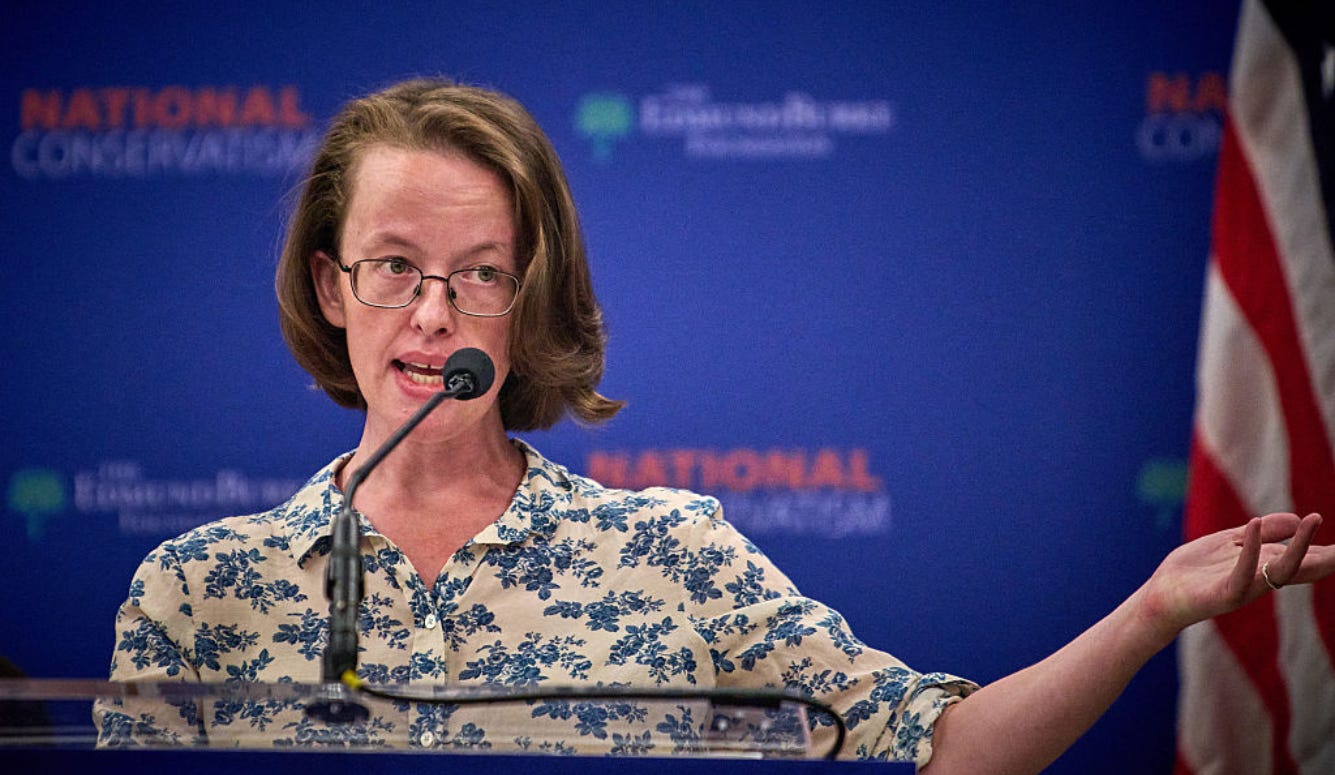
Helen Andrews is the former senior editor at The American Conservative, as well as the former managing editor of The Washington Examiner. Her first book, Boomers: The Men And Women Who Promised Freedom And Delivered Disaster, was published in 2021.
Why did we invite her on?
In October, Helen published a piece in Compact Mag called ‘The Great Feminization’. In it, she detailed what she perceived to be widespread and deep-rooted ‘feminising’ shifts in society, and why it would inevitably cost us.
The article quickly became the talk of centre-right circles, inviting praise and endorsement from many of the movement’s most celebrated figures. With our then-upcoming America trip scheduled, we quickly put Helen’s name on our wishlist. She agreed. This is our conversation.
What did we learn?
It’s difficult to have conversations like these without sounding misogynistic.
Quite often, that’s where they end up. Blaming women for all modern problems, and the downfall of the West, and so on and so forth. Many critics of Helen’s article saw it as just that - a sweeping dismissal of women and their role in society.
Helen is keen to correct that, but without sacrificing the core of her argument.
“Feminisation has caused one specific problem: wokeness.”
Helen admits this wasn’t a field she ever thought she’d be interested in. The ‘mythology’ of gender discrepancies was simply not something that enflamed her imagination. Until 2020. Then, they become impossible to ignore.
”I was baffled by the woke phenomenon. Why did everyone go crazy in the summer of 2020? It seemed like mass hysteria. The more I thought about what caused it … [I realised] it was feminine patterns of behaviour applied to institutions where women have not been well-represented until recently.”
It sounds like a remarkably simple catalyst for such a profound paradigm shift. 2020 was a wild year for a number of larger, more radically apparent reasons. How could some meagre demographic changes upend the whole structure? What are these ‘feminine patterns of behaviour?’
”Women are more consensus-oriented. When men approach a question, they ask ‘What are the facts?’, ‘What are the rules?’. Women will wonder what the relationships are, and how to make everyone happy. That explains wokeness to me. The white-collar workforce is majority female. The fact that all the institutions tipped over into wokeness when this change happened… it couldn’t be a coincidence.”
Perhaps not, but this change didn’t come overnight. These institutions weren’t all-male and then suddenly majority-female. The presence of women was steadily increasing for decades, but why did it all seem to change so fast? Does going from 49% women to 51% women really make such a meaningful difference?
”Some things are binary - the majority matters. How do you deal with conflict? You can do that in a masculine way or a feminine way. Once you get a critical mass, you have to make a choice.”
And it’s in these situations where the fundamental differences between men and women manifest. Suddenly, a corporation’s entire ethos can shift, and the shifts are easily predicted.
”One of the most consistent psychological differences is women’s strong impulse of caring … It’s Darwinian; women see helpless things and want to take care of them. Wokeness weaponises that. If you can frame your political movement as caring for a particular helpless class, you’re golden.”
Here, Konstantin recalls a conversation he had with Jordan Peterson. Peterson asserted that there are three categories of relationships that women assign others to: baby, caregiver, and potential enemy. Babies require help, caregivers provide it, and anyone outside of those relationships is a possible threat. With that framework, one can understand why the pet issues of wokeness were taken up.
But is this necessarily a negative thing?
