


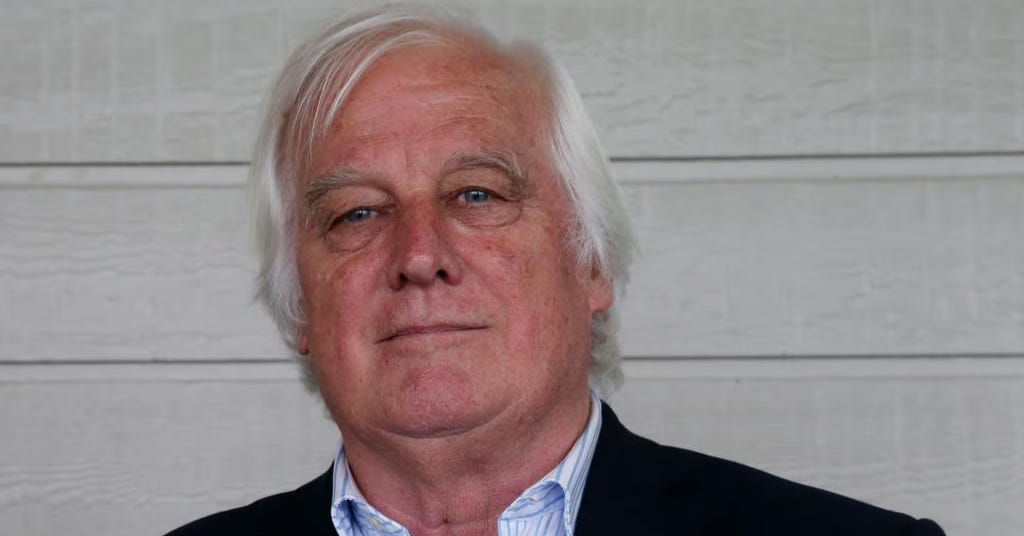
”I think you should tell your Prime Minister that he breathes in 0.04% carbon dioxide and he breathes out 4%. So if he wants to be carbon neutral, he should drop dead.”
Ian Plimer is one of Australia’s most infamous scientific minds. To some, he’s an iconoclastic rebel, bravely standing against the debilitating rhetoric of his community. To others, he’s a kook, recklessly undermining the efforts of finer scientists to remedy the most pressing issue of our time: climate change.
A ferociously vocal critic, ‘sceptic’ isn’t a strong enough word for his position - he is defiantly, wholesale opposed to the consensus that exists among the vast majority of his peers.
We are fascinated by anyone who speaks out, and have been curious about Ian’s positions for some time. Crucially, Ian’s no quack. Today, he’s the professor emeritus at the University of Melbourne, and worked on-and-off as a lecturer for several universities over the preceding decades. So why does he cut so strongly against the ride? If the costs for speaking out are so high, what motivates him to do it? Is there something there?
What did we talk about?
Ian’s suspicion of ‘climate science’ has made him a pariah. But his guardedness didn’t start there. In the ‘90s, Ian rose to prominence as a critic of creationism - the belief that the Earth is 4,000 years old, the ‘ancient sediment’ we can observe in our global geology is the result of a historic flood. That’s when he realised even the truth can be weaponised for deception.
”That’s when I realised that there was a very large body of people out there using ‘science’ to promote scams. They were very religious and very misguided. [Later], I saw the same thing in the late ‘90s with climate change.”
It’s an easy, if underhanded, debate technique to describe your opponent as “brainwashed”, or a “cult member”, or “religiously” minded. It imposes on them a degree of gullibility and fundamentalism. You don’t believe this because the evidence backs it up, but because you want it to be true. To Ian, it’s more than a shallow similarity.
”It has all the hallmarks of religion. Sin, redemption, paying penance, having to give things up - the leaders of the religion don’t have to, but the common man does. I started looking at the science, and the evidence didn’t align at all with my area of science: geology. That’s my speciality, but I’m a polymath, and I could very quickly see that this wasn’t science. I could see a big business coming behind it, so I thought it was time to stand up.”
We’re so often told that “all scientists agree” on the climate change ‘consensus’. The numbers thrown around are unlike those regarding any other field of study - some reports put it at exceeding 99%.
How did they get to this number? Ian’s answer is simple: not everyone was asked.
”If you look at the IPCC reports, there’s no geology or palaeontology. And those are the clues for the temperatures and sea levels! That’s how you find out...”
When you look, what do you see?
”You can look at the rocks and back-calculate how much carbon was in the atmosphere. Over the past 5 million years, we’ve had a decrease in carbon dioxide. [In fact], it’s dangerously low. If we halved it, we’d have no vegetation … We’ve seen cycles of climate in the past. Very warm periods, very cold periods … We see sea levels going up and down all the time. Darwin wrote a book about it in 1842!”
Put succinctly as possible, the climate story is as follows…
Human activity is putting unnatural levels of carbon into the atmosphere, and its presence is wrecking the atmospheric balance, causing the planet to heat. Ian’s findings don’t merely cast doubt on the given narrative; they render it incoherent. Not only that - their evidence doesn’t support it.
”We’ve had times in the planet where there is hundreds of times more carbon dioxide in the atmosphere than there is today. And that’s when we enjoyed the greatest ice age in the history of our planet. We have kilometres of ice at the equator, and the evidence is in the rocks. It’s incontrovertible. There’s no relationship between carbon and temperature. There’s not one scientific paper that demonstrates human emissions drive global warming. If there were, you’d never hear the end of it.”
If that’s true, why don’t we hear about it?
Science is the ongoing process of getting things wrong. We have to forgive researchers for that. If we didn’t, we’d never learn more.
That doesn’t seem to be what’s going on here. It sounds like ‘climate scientists’ are pushing something they don’t have reason to.
If the evidence doesn’t support the hypothesis, why hasn’t it just been dropped? Where does the motivation to push an allegedly unfounded argument come from? Isn’t that the antithesis of good science?
”This is the biggest cult in the history of science.”
Why?
