


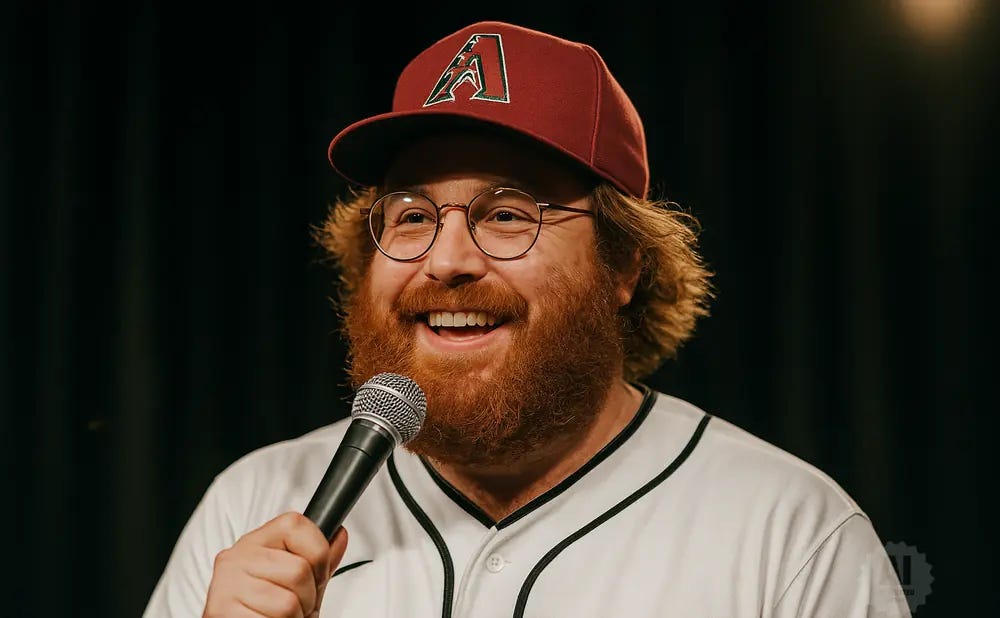
Comedy is a brutal industry. Even if you’re lucky enough to be right at the culture’s epicentre, success is as unlikely as failure is familiar and painful. James McCann is not only one of the most popular young comics of the last decade, but one of the few international acts to crack America in that time.
In Australia, he produced an award-winning run of hilarious, maverick hours, and
following a run opening for star comic and Trig favourite Mark Normand, he became a Kill Tony regular last year. Since, he has established himself as a regular face on the podcast circuit, appearing twice on Rogan in the last 6 months alone.
Why did we invite him on?
As much as we love sitting down with politicians, philosophers, economists, scientists, historians, psychoanalysts and radical thinkers, there is no substitute for an uncensored conversation with a hilarious comedian. Plug in the kit, hit record, and let their wild minds roam free.
No expectations.
No agenda.
No-holds-barred.
James’ work is imbued with natural and irrepressible curiosity, exploring culture, science, and human nature, all in his trademark style.
We knew he’d be a perfect fit for our show. What we didn’t know is just how strange that ‘perfect fit would be.
What did we talk about?
”The British… You’re all touchy about Grenfell Tower. It’s like the n-word… Really takes the air out of the room.”
The first words out of our guest’s mouth are him querying a national tragedy. It’s been about 45 seconds since we started rolling. Bodes well.
We didn’t go into this interview prepared, and that was deliberate. We didn’t want to dictate the course of chat; so much of James’ appeal is in his free-wheeling craic, and trying to put guard rails on it would be to miss the point entirely.
Perhaps we should have.
James seems more fascinated in us than we are in him. A self-evident and well-read Anglophile, he’s keen to talk about our little island. And there’s more telling than asking.
”As a country, you’re very comfortable with the deep state. You had a sitcom [Yes Minister] explaining how it worked. In America, they’re all “it’s a deep state”, they’re conspiratorial. You guys go ‘Of course! Of course there are people working behind the scenes!”
From there, James regails us with stories of his time in our capital. Recently, he spent two weeks in London. A clearly intelligent person, we imagine he spent the fortnight enjoying its theatre, bookshops, restaurants, museums, landma-
”I went to a convenience store where they had ski masks and knives behind the counter, next to each other. That’s too convenient. If you’re gonna murder someone, you gotta go to two stores.”
Just as quickly as that comment reaches our ears, James pivots to another.
”What happened to the grooming gangs? When I was there years ago, everybody acknowledged it… Liberals, Guardian readers.. And then it all went quiet, what’s happening there?”
Before Konstantin has time to ellucidate on the complex and frayed nature of race relations here in Britain, or the unwillingness of politicians to do or say that which might make them unpopular or might present a challenge to thei-
”I didn’t want to talk about Enoch Powell.”
