


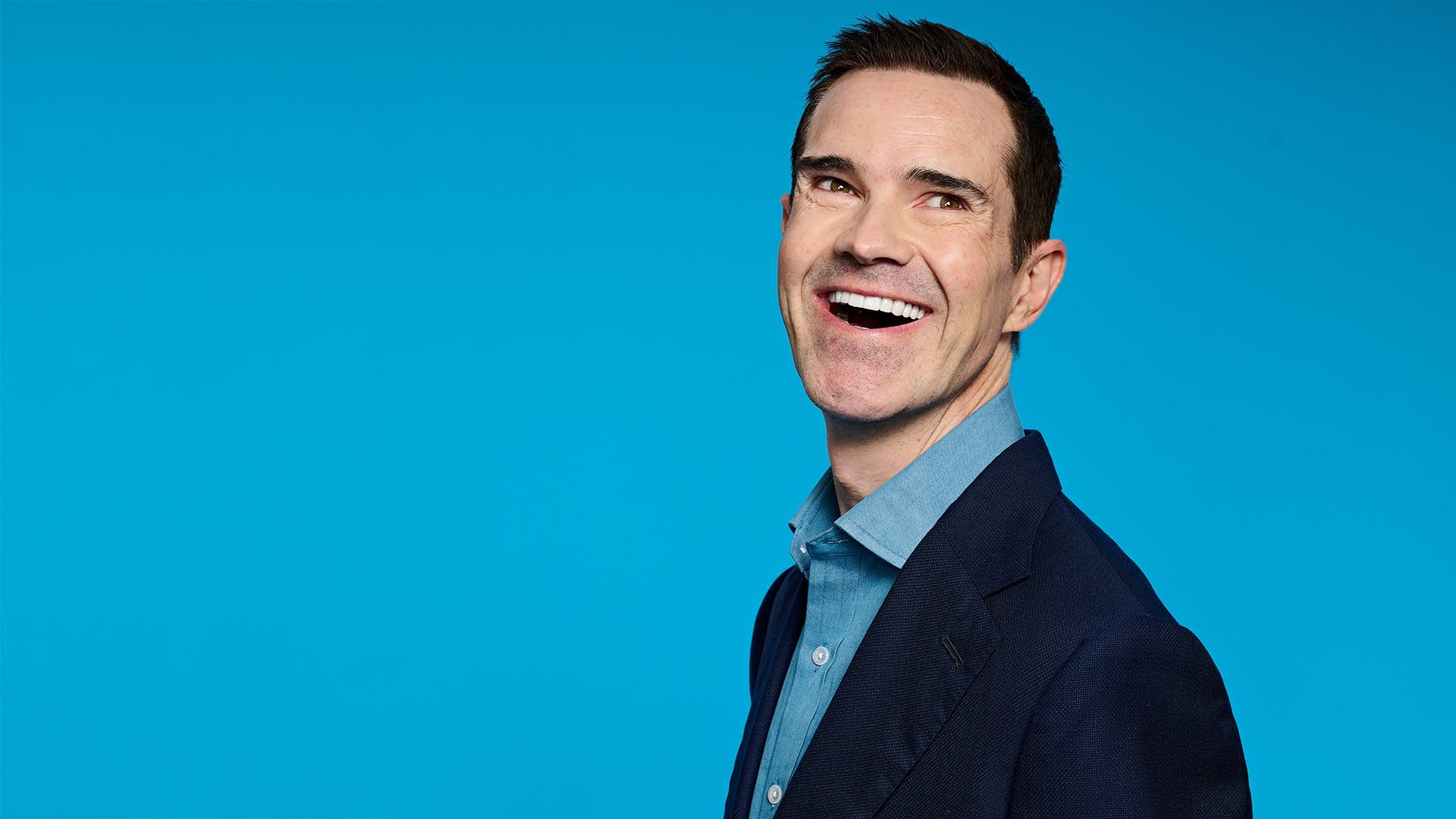
Jimmy Carr might be the busiest man in show business. Rising to prominence with a unique blend of wince-inducing black comedy and a clean-cut performance style, Jimmy has spent nearly two decades as a television mainstay, hosting several of Britain’s most popular panel shows, including 8 Out Of 10 Cats, its Countdown spin-off, and The Big Fat Quiz Of The Year. Today, he is touring his latest stand-up show - Laughs Funny - and preparing for the premiere of his first co-write/co-star feature: Fackham Hall.
Why did we invite him?
In his scant downtime, Jimmy has recently established himself on a whole new circuit: podcasts. Guesting on the likes of Joe Rogan, Chris Williamson, Michael Malice, Neal Brennan, and Stephen Bartlett, Jimmy has found an outlet for his one-of-a-kind outlook on politics, psychology and philosophy. Last time we hosted him, we explored religion, economic theory, and the importance of positive thinking. It was a tremendous conversation, and we were eager for another around.
What did we talk about?
”We are at the start of a revolution.”
Jimmy’s comedic style is defined by taut, tight set-ups and punchlines. In conversation, he’s as big-picture as they come. An economy of words is present in both.
We’re often told we’re at the precipice of a major change. Constant warnings of a paradigm shift, and yet things remain demoralisingly static. “Revolution” is a loaded term, evoking images of decapitated despots and blood in the gutters. Is Jimmy overstating the case? He thinks not.
”What is a revolution? It’s the replacement of the elites. Look at the BBC and what they’ve gone through over the last month. That is an elite organisation, and it’s in turmoil, and it’s being replaced by podcasts hosted by individuals. There used to be an elite that ran this country, and always either Labour or Tory. At the next election, they will be replaced.”
Bloodless revolutions are not benign. Jimmy explains that, right before our eyes, there has been an Orwellian overhaul of these institutions - their labels no longer describe what they do and who they serve. For a while, the public hadn’t caught up. Now, it can’t be ignored.
”There’s been a gentrification of the Labour Party. It used to be the party of the working man, and it isn’t anymore. The white van man who they used to represent, he now votes for Reform. When did that happen? Why? I don’t know if this is the end of liberalism, but it might be.”
But isn’t ‘liberalism’ the terrain of the left? Why would an ostensibly left-wing party with a strong majority be ‘the end of liberalism?’ To Jimmy, theirs is a liberalism in name only.
”Digital ID is f*cking terrifying. Even if the ‘good guys’ have the power now, we don’t know what’s coming down the pike. Do you know why the Nazis were able to kill more Jews from the Netherlands than France? Better records. The Dutch had better records.”
It’s easy to take for granted, but it’s worth reminding ourselves: liberal society is not a given. It’s a remarkable mutation. On the scale of all history, it’s a blip. It could disappear, much more quickly than it arrived. If it’s happening already, why?
”Our foundation myth is World War II, and you can see it crumbling. People are questioning who was the goodie and who was the baddie, so the myth doesn’t work anymore.”
To Jimmy, the answer is simple: it’s failing people. The institutions and their leaders have rested on their laurels for too long - they’ve allowed their standards to slip, and our expectations of them have matched that decline. Faith in democracy is in the toilet - whoever wins, you get higher taxes, tighter restrictions, and smaller ideas. Change must come, and fast. The time for gradual, incremental shifts is over - it’s time to get radical. There isn’t much time.
”The Industrial Revolution rendered our bodies obsolete. It’s changed everything. The workforce used to be mostly farmers, but once we had combine harvesters, those farmers had time, and they could work in the factories. AI will do the same for repetitive jobs, and it’ll change everything again. Maybe it’ll even take the creative jobs. Then what’s left? … We need to stop litigating communism and fascism. We need new ideas. Let’s test them. ”
But communism and fascism weren’t lessons in ‘testing new ideas’; they were lessons in what happens when radical thinkers chase their ideas at the cost of everything else. Sure, everyone having an equal share of the society’s wealth sounds good, if you ignore the millions dead. Is that a cost worth paying?
Radicalism doesn’t demand we change everything - it describes a willingness to change anything. No more grandfathered-in millstones, no more idols.
Where would Jimmy start?
”What if we didn’t tax anyone in their 20s? Under-30, no tax. Already, you’re incentivising people to get jobs. University is a luxury item, and luxury items don’t work if everyone gets them. They’re supposed to be for elites - they’re also supposed to be free. Tax between 30 and 60 and then stop. I think that would be interesting. ‘Universal basic income might take away purpose from people.’ Maybe, but let’s find out. Let’s try it in some regions and compare the results. Let’s test it. Tradition is just an experiment that worked.”
With the economy handled, Jimmy sets his sights on the most sacred of all cows - the NHS.
