


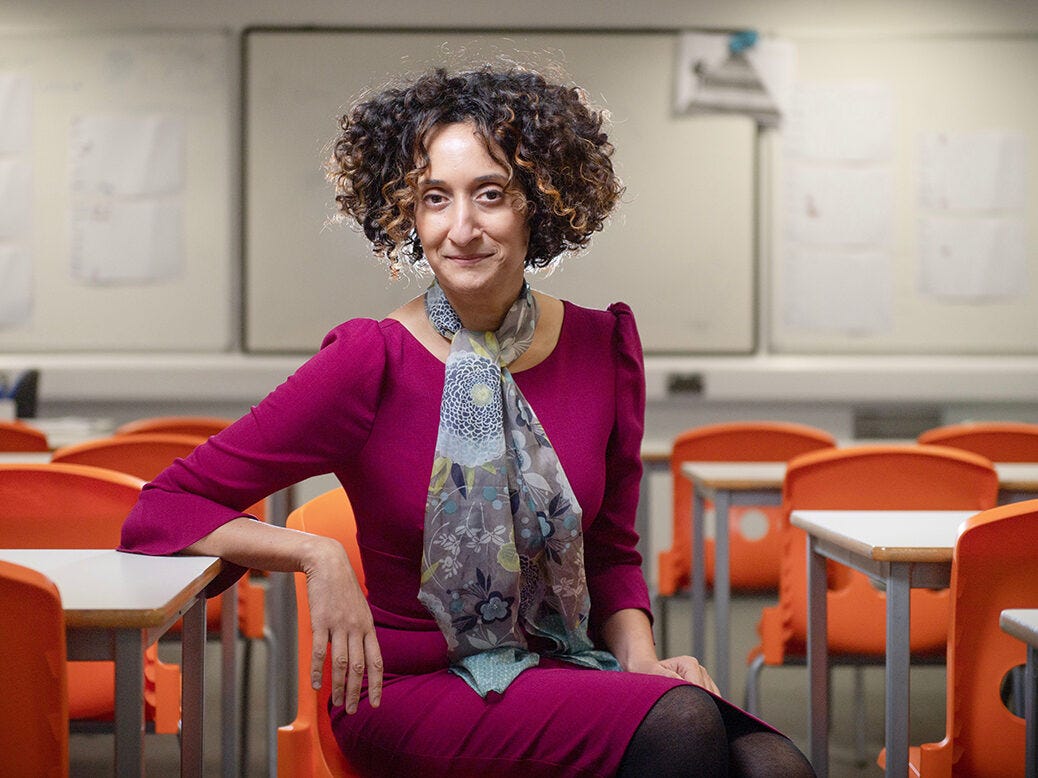
There aren’t many school teachers who can boast the resume and name recognition of Katharine Birbalsingh.
In 2007, she began writing her popular blog - To Miss With Love - on the subject of education under the pseudonym Miss Snuffy. Seven years later, she would make her prescriptions a reality by founding Michaela Community School, a free secondary school in Wembley which, for over a decade, has boasted some of the best test results in thecountry.
Since then, she has authored and edited several books, and in 2022, was the subject of an ITV documentary titled “Britain’s Strictest Headmistress”. In 2020, she was appointed Commander of the Order of the British Empire, and appointed chair of the Social Mobility Commission the following year.
Why did we invite her on?
Katharine has been a regular guest since the dawn of Triggernometry; our next episode actually marks her fourth appearance. She’s long been our go-to authority on all things education, which is a subject that has only become more pressing since we started.
Every year, it feels like there is more to discuss. In light of France’s latest eruption of riots, there’s even more than usual. We invited Katharine on to give some background to these spasms of activity, explain their deep-rooted origins, and what they forecast for the West more broadly.
What did we learn?
”I’ve spent my career trying to communicate how important childhood is to our country. Everyone wants to know why we’re in the mess we’re in, and it’s because of what we’re doing to our children.”
The factors, big and small, that affect any one child are countless. Scale that up to an entire generation, and it’s impossible to know where precisely to begin. Home lives, relationships, parental figures and lack thereof, nutrition, wellbeing, exercise, access to resources - these are but a few of the determinants that will shape a child’s life outcomes for years to come.
It can’t all be policed. All we can do is what we can. In the mind of Katharine, that starts in school, and just one of the factors contributing to this general sense of unease is the “infiltration of white guilt” in our educational institutions.
”If you think back to ‘95, there may have been a little bit of white guilt here and there, but it wasn’t overpowering like it is now … I know there are many progressives who will tell you it doesn’t exist, but the last 15 years show us a difference. Our institutions are reacting differently, and that includes schools. We all know something is not quite right.”
This line of thinking is often mistaken for racialism; a belief that white people feel so guilty and ashamed because they’re put upon by ethnic minorities, and that that’s why both parties are lashing out.
This, Katharine stresses, is a mistake. It’s a criticism she is, as Konstantin puts it, “uniquely placed” to be express.
”The right goes wrong on this; they think it’s all the black and brown people who ar the problem. It’s easy to say that, and there are some black and brown people who are a problem. But the thing with black and brown people is, well, we live here. You can’t “send us home”, and even if you could, it wouldn’t fix everything. The institutions are, frankly, full of white people, and lots of them are riddled with white guilt.”
Michaela is situated in one of the most diverse parts of Britain - Wembley, London. Highly multi-ethnic, and highly multicultural. You might naturally suspect that they’d face as much pressure as any school to not exhibit signs of patriotism, if not more so.
”We fly a British flag outside our school, and it’s the only flag we fly. We sing ‘God Save the King’ every single morning. It used to be normal. Nowadays, it’s considered offensive. It’s very hard to find a school where they would do that. I’ve never heard of one. Other schools, they’ll have trans flags and pride flags and Palestinian flags. A problem comes when you’re obsessed with celebrating other cultures at the expense of the British one.”
This opens up a whole new conversation, and one we’ve - quite infamously - had on the show before: what is British culture? What’s more - what is the British identity?
Michaela hosts students of all ethnicities and creeds; any kind of identity rooted in Anglo-Saxon heritage clearly isn’t going to cut it. However, there are questions as to whether the British identity - which can be claimed by any citizen - is too amorphous to mean anything, and inevitably unravels into nothing. Can one take pride in a group that anyone can join? Should they be proud of a group that excludes others? How do we balance these tensions?
