


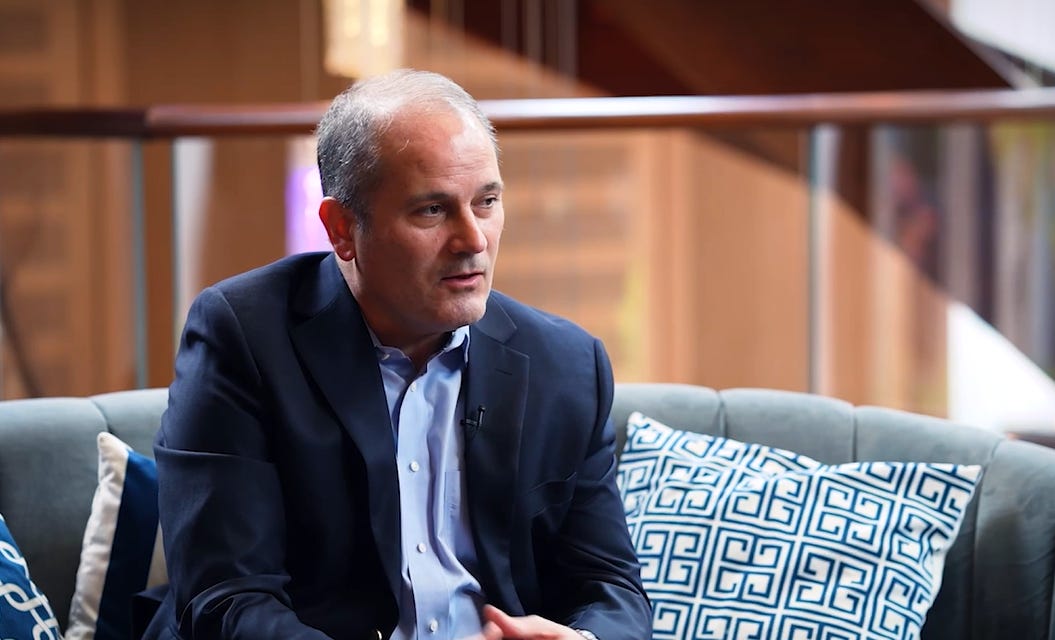
Even among esteemed historians, Mark Moyar’s resume is baffling.
As an academic, he holds degrees from Harvard and Cambridge, while as a writer, he has been published by The New York Times, The Wall Street Journal and the Washington Post. He is also the former Director of the Office for Civilian-Military Cooperation at the US Agency for International Development (USAID), appointed under President Trump. Today, he is Chair of Military History at Hillsdale College.
Why did we invite him on?
Across the dozens of conversations we’ve had with historians, we’ve covered the majority of the modern West’s wars. Yet, we’ve never tackled the most contentious of them all…
Vietnam.
It traumatised a generation, rewired global relations, and utterly recalibrated how Americans saw themselves on the world stage. Nearly 70 years later, it acts as a fable for nations out over their skis. A lesson in what can happen if you don’t see your own weakness.
In the string of American interventions since - Libya, Syria, Iraq, Afghanistan, and now Iran - Americans have become increasingly suspicious of foreign military action. It’s unsurprising - the distance between them and their last decisive victory, like (and with) the mythos of Vietnam, has only grown.
In 2007, Mark published one of the most controversial books ever to be released on the subject. Triumph Forsaken invited critical praise and academic criticism for its radical overhaul of the historical orthodoxy, and remains one of the most widely-discussed Vietnam books of the 21st century.
We wanted to get Mark’s expert perspective on this thorny subject. Should it be? Is the story of Vietnam overstated? Is it understated?
What did we learn?
”Lyndon B. Johnson didn’t explain to Americans why it was important. Compare him to FDR; he was out there, explaining why entering WWII was the right thing to do, why it was a fight worth having. Nixon tries to do it later, but it should have been done long ago. There’s a good case for it; Johnson just didn’t make it.”
Historical orthodoxy tells us that Vietnam was doomed from the start. There’s ample reason to believe it; the factors that made this war more complex and challenging than its predecessors are in such multitudes that there’s no hope of listing them all.
Scholars still debate what was most significant. Some argue that it was the increasing division at home. The civil rights movement brought about a new racial consciousness in millions of black Americans, many of whom resisted the draft - fruitlessly, as black men were enlisted at a rate above the national average. When Muhammad Ali refused to fight, he inspired countless others to follow suit. If America couldn’t depend on its own population to focus on its war, what chance did it have in the jungles of Asia?
Others suggest the Viet Cong had an insurmountable advantage. Not only could they retreat into the dense rainforests, a terrain the Americans could never hope to understand, but into neighbouring countries as well. The Americans had no place to return to. They were stranded, surrounded by an enemy they couldn’t see, much less understand.
Or perhaps it was the drugs. By the late ‘60s, heroin had run rampant through American platoons, debilitating soldiers with a habit that rendered them useless whether or not they were on it. Already facing the natural advantages of their enemy, how could the paranoid, exhausted, sick men in American uniform stand a chance?
Then again, perhaps all of this could have been remedied by one thing: support.
The nation’s morale is an undeniably crucial factor in its military outcomes. If the boys abroad know their wives and children and peers and parents are at home smiling with pride, they might will themselves to make them right. Instead, the American public - if it ever had been in favour of it - was turning ever more against their own fighters. Horrific images were broadcast into homes, stories from the battlefield trickled back, and evidence of criminal conduct by certain platoons was starting to emerge. Once they saw what ‘winning’ meant, the US no longer wanted it.
As Mark explains, none of these can be dismissed. With his forensic level of expertise, he is able to seamlessly guide us through the dizzying array of factors that contributed to American failure in the tropics.
”A lot of historians, especially on the left, will claim that this war could never have been won. There was nothing America could have done differently to secure victory. I think they could have.”
How?
