


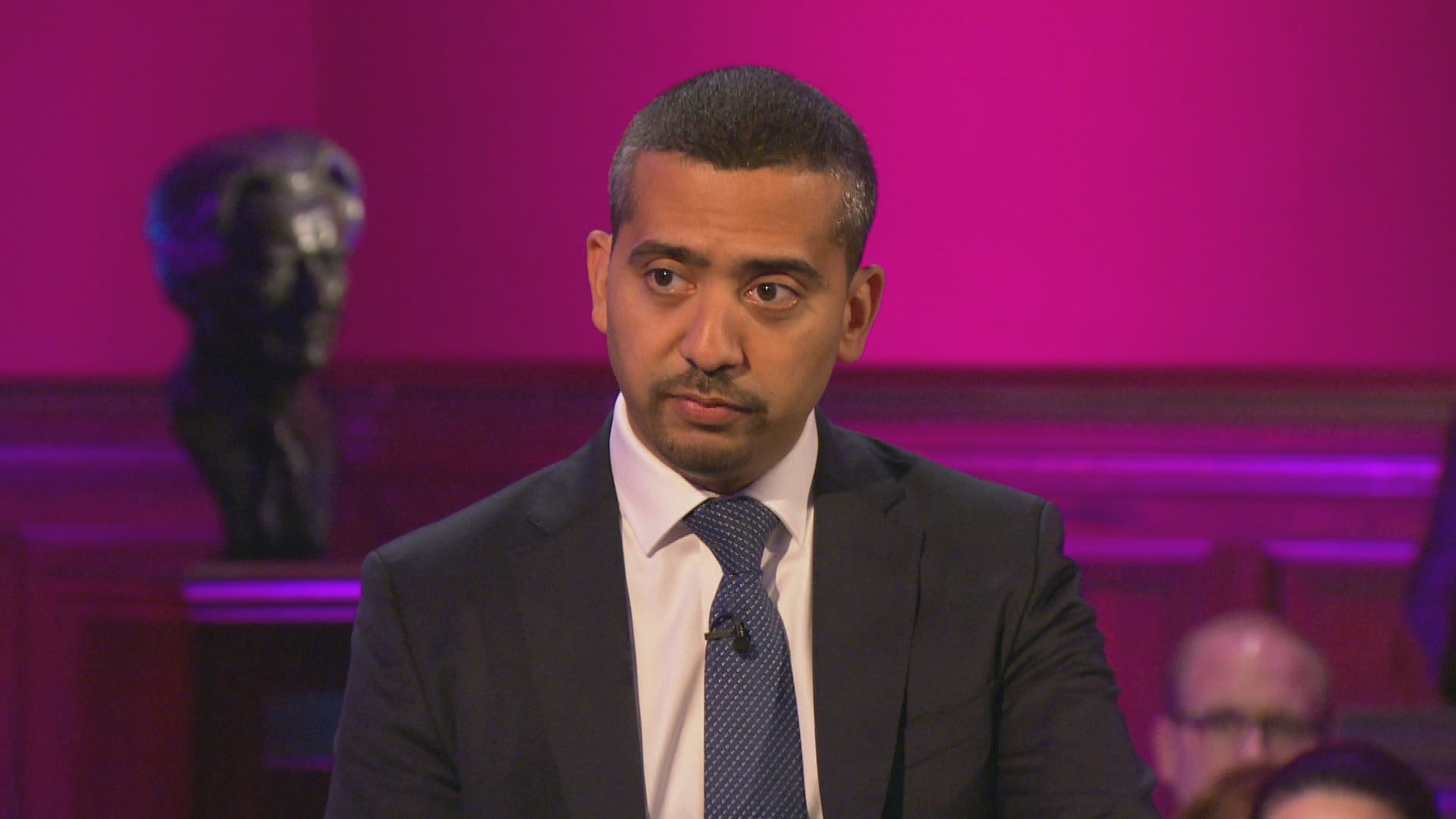
Mehdi Hasan is one of the most prolific, admired and fierce left-wing commentators of his generation.
Across his 25 years in journalism, Mehdi has held almost every kind of job going. He’s been politics and news editor for Channel 4, The New Statesman and the Huffington Post, all before 2012 when he became a long-time presenter for Al Jazeera. Moving to the States, he then presented The Mehdi Hasan Show on Peacock from October 2020 and on MSNBC from February 2021. When the show was cancelled in 2023, Mehdi swiftly left the company, opting to start his own: Zeteo, an alternative news outlet focused on progressive ideals. Today, while continuing to lead Zeteo, he also hosts Head To Head on Al-Jazeera and writes for The Guardian.
Why did we invite him on?
This marks the third of an ongoing series of interviews we’re publishing on the Iran War. First was Senator Ted Cruz, pitching the argument-in-favour from the right, then strategist and political advisor Professor Robert Pape joined us to oppose it from the centre.
Now, Mehdi is here to give the left-wing case against it.
Many MAGA pundits have tried to paint today’s anti-war movement as either just another weak-limbed, lilly-livered pet-project by the anti-Trump pearl-clutchers. Suspecting there’s more to the story than that, we thought it would be best to speak to one of the left’s most heralded voices.
What did we learn?
We don’t need to go over how polarising and unusual this war is. The situation has been laid out ad nauseum. Still, it’s interesting to hear what people who have dedicated their lives to predicting and reporting politics make of it.
Mehdi doesn’t mince words.
”I think it’s a disaster. I don’t think it was legal. I don’t think it was justifiable. I don’t think it was necessary. I think it’s self-destructive. I don’t think it’s in the US national interest, and I think a lot of innocent people are being killed as we speak and without any real justification.”
A key problem even many of Trump’s traditional supporters find themselves running into regarding Iran is the objective (or lack thereof). Secretary of War Pete Hegseth is quick to tell the people that America’s “objectives are clear”, but are they? The justification for this war seems to change depending on the day, and each explanation is more incoherent than the last. In Mehdi’s estimation, why is it happening?
”Many reasons, but one was expressed by Marco Rubio before he walked it back. I’m paraphrasing, but he said that Israel was going to attack Iran, and if Iran was attacked they would attack [America], so they decided to attack first. It’s insane on multiple levels. If you think Israel is going to attack Iran, just stop them; they’re your client state. It’s like saying that you think your brother is going to get drunk and crash the family car, so you’re going to wreck it first. It’s a bizarre argument.”
Many of those same former supporters feel that Trump broke his promise. On the campaign trail, Trump was keen to stress his success rate in his previous administration: No New Wars. In fact, he dissuaded voters away from Kamala Harris on that basis - if she gets in, there’ll be war in Iran. He won, and still war came. He changed. Or did he?
”I never bought the bullsh*t shtick that Trump was anti-war. He was pretty beligerent in his first term … expanding drone strikes, bombing Somalia… there was nothing in his first term that said this guy wasn’t totally happy with war. Unfortunately, I’ve been vindicated.”
Still, Trump’s been in power before. He started zero new wars in his previous presidency - a fact he ran on - and the opportunity to engage with Iran was on the table then, yet he didn’t take it. What changed? Why now?
”Leaders, when they’re unpopular at home, start wars abroad. My company did a poll that revealed 52% of Americans believed this war was at least partially launched to distract from the Epstein scandal! You might think that’s a mad conspiracy theory, but most Americans believe it. He’s not just doubling down, he’s quadrupling down.”
Fundamentally, at the root of all of these factors, is one key ingredient: Israel.
After enjoying record-high support in the wake of October 7th, Israel’s public image on the world stage has crumbled. Across Europe and the Middle East, the state’s reputation is in tatters. Most shockingly of all, it’s become increasingly true in America. The Democratic base were the first to pull back, but even Republicans are starting to ask questions.
These questions were enflamed by the recent resignation of decorated veteran and former director of the National Counterterrorism Center, Joe Kent. In his parting statement, Kent stated plainly that this was a war in Israel’s interest and against America’s. To many, it confirmed what they’d long suspected: Israel, America’s client state, was in charge.
Mehdi has no shortage of criticisms for Israel, what does he make of the accusation? His answer is more nuanced than you might have suspected.
”Netanyahu’s on the record saying he’s wanted to attack Iran for 40 years and Trump is the first President who has allowed him to do it. But I think that takes away too much responsibility from Trump, Lindsay Graham and all the hawks in government who have wanted this war for years.”
So, if Israel isn’t the totalitarian-mob-boss it’s often painted as, what is its relationship to the US? Does Mehdi think it has some kind of undue, nefarious influence on the West’s greatest superpower?
”This is not a conspiracy theory. The beauty of these Republicans - their only redeeming feature - is they say the quiet part out loud. We don’t even need to speculate. Lindsey Graham tells us that he coached Netanyahu on how to convince Trump to go to war. Bizarre - a Senator and a foreign leader discussing how to manipulate the President of the Senator’s country … Ted Cruz said in that viral interview with Tucker that he wanted to be the #1 defender of Israel in America. You don’t get other politicians saying that about any other country. There’s nobody in American politics who wants to be the #1 defender of Belgium.”
It’s certainly unusual, but does it prove anything? Could it not just be that these politicians, for whatever personal or religious or strategic reason, believe Israel is an ally that America must keep?
”That’s 100% true. But there are also a bunch of people in American politics, and I know this because they tell me on and off the record, that support Israel because they’re worried about the consequences if they don’t. They’re worried about being primaried, they’re worried about losing their jobs, about being called antisemitic, or being targeted by AIPAC. The idea that there isn’t a very powerful Israeli lobby is absurd.”
To Mehdi, the proof is only becoming more apparent. Before Israel’s war in Gaza, Americans were broadly in support of the Jewish state, and elected officials could camouflage themselves with their base. Now, as the voters become increasingly hostile to Israel, that protection is lifted. The fact these politicians haven’t responded tells you everything.
”You poll Democratic voters and ask whether they support what Israel is doing in Gaza, 8% say ‘Yes’. Among Democrats in Congress, it’s reversed. Why? For the first time in my lifetime, and it’s something I thought I’d never see, Americans are supporting Palestinians more than Israel. It took a genocide for them to switch their position, but it’s happening. If that doesn’t translate into Congress or the Presidency, you have to ask why.”
Well, if Israel has a domineering sway over American politics, the same must be said for Iran and its neighbours. The second most-populous country in the Middle East, it’s also the foremost sponsor of terror groups in the region and boasts extraordinary controls over the world’s fuel supply. By that logic, just as Mehdi might welcome a new government in Israel, should he not hope the same for Iran? For the Middle East, could this not lead to a new era of prosperity, stability and peace?
