


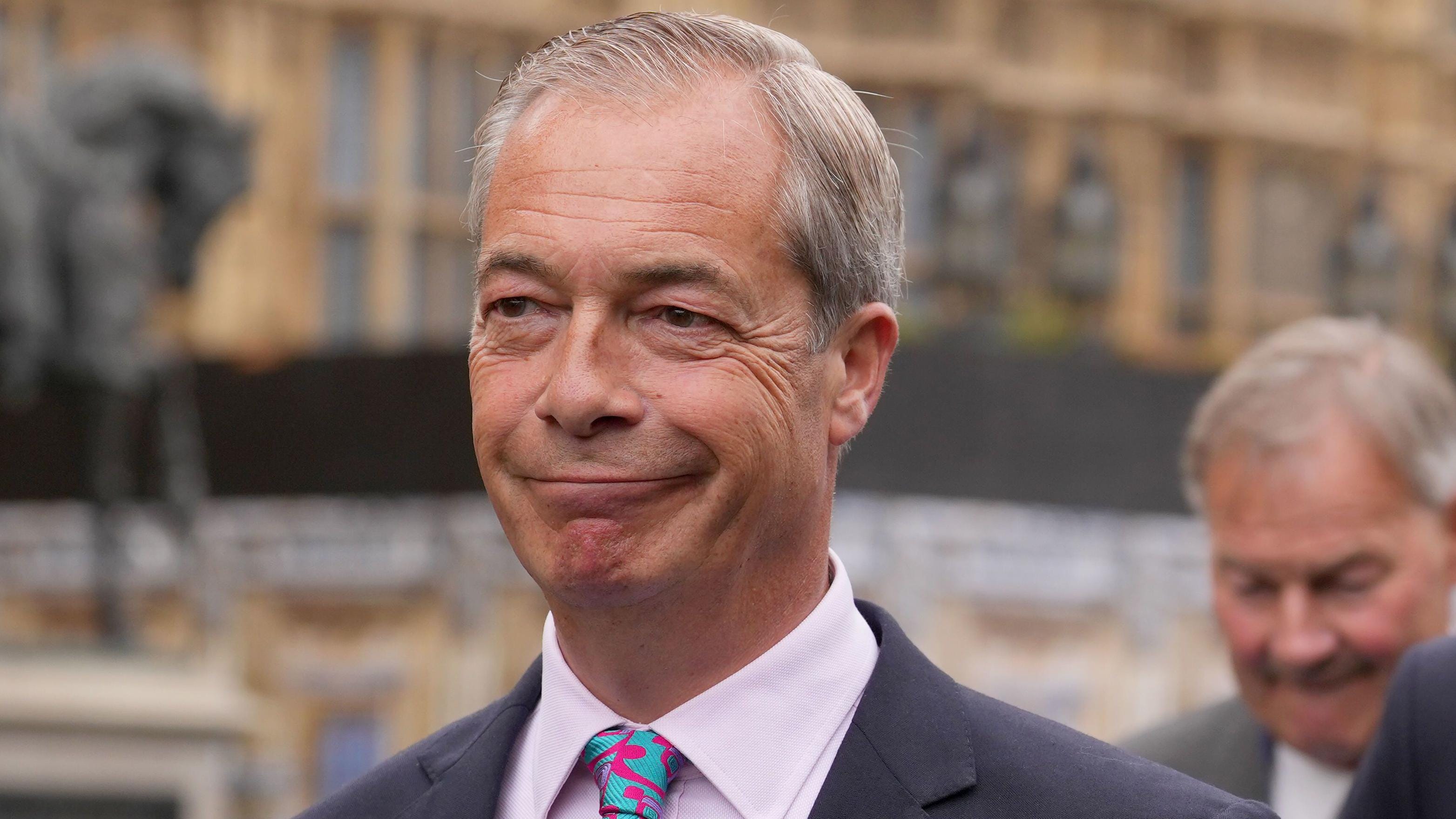
Everybody has an opinion on Nigel Farage.
To some, he’s the heir apparent to Enoch Powell, the face of English bigotry. To others, he’s a lovable rogue, the parliamentary phoenix of right-wing politics - an unsmotherable force that, despite everything that comes his way, shapes and defines the movement in his image.
He’s Britain’s most divisive politician of the 21st century and arguably the most influential to never hold the top office.
That might soon change.
Today, according to recent polls by IPSOS, YouGov, and Freshwater Strategy, Reform UK is the most popular political party in the country, and the favourite to win the next general election.
Why did we invite him on?
Nigel is never far from controversy. The scorn he faces is often commensurate with the adulation he enjoys. As Reform continues to enjoy a surge in public support, the predictable tide of scrutiny comes his way. It’s a pattern as old as his career in politics.
The last month, however, has proven to be one of his most testing yet. Between scandal and tragedy, Farage and his party have been put through the wringer. We wanted to get a sense of what things are like in the eye of the storm. Is this another test in the long and storied history of a divisive firebrand, or are we looking at the end of one’s public life?
What did we learn?
Our conversation comes mere days in the wake of Ann Widdecombe’s shocking murder. A well-known conservative voice and Reform Party spokesperson, Nigel had a close relationship with Ann; though we initially planned to focus on the by-election, it would be wrong to not start the discussion there. Nigel asserts that the two events are not so disparate.
”They’re directly linked. The full-scale attack on Reform, which has really gone into gear since May 7th. Why May 7th? Massive set of elections across the UK. We wipe out the Conservatives in East Anglia… unbelievable. We take out Labour in Northern England, the Midlands, we make big breakthroughs in Scotland and Wales. Ever since that moment, the attacks on the party have been unrelenting. [They say] we are extremists, a threat to Britain, more dangerous than Putin, and we’re all criminals. This is the narrative that’s going out unendingly.”
Nigel’s used to scrutiny; over four decades in political life, he’s faced his share of barbs and jabs. He even welcomes it. This, he believes, is different; the political tension we’re seeing, the will for violence, is unlike anything he’s witnessed in his lifetime.
”I’ve been in this game a long time. I’m used to the rough and tumble of politics. In a way, that’s what democracy is … But when stuff going out in national newspapers that is simply untrue, or exaggerated beyond belief… If you demonise people, like in Ann’s case, because they don’t believe in gay marriage, or have strict views on abortion, or they believe in strict immigration control… If you dehumanise them, is it surprising that it engenders a form of hate?”
And hate, to Nigel, contrary to what initial official reports suggested, is what this is.
”It was obvious to me from the first moment that this was politically motivated and premeditated. It was an assassination, directly downstream from the anti-Reform campaign waged by the House of Commons and the mainstream media every week.”
Things are at a crossroads; they can go one of two ways. This either results in a normalising of sociopolitically inspired acts of terror or a realisation that we’ve already let things go too far. With, as Konstantin notes, Gen-Z up to 7 times more in favour of political violence than previous generations, they don’t look promising.
”[The left] so believe in their righteous virtue that they feel allowed [to say anything they want]. I cannot think of a single conservative commentator who would ever say anything approaching that about the death of a senior public figure. If Jeremy Corbyn died, I’d say ‘I don’t agree with him, but he believed in what he believed in, and he fought for it for decades.’ That’s the difference here.”
It’s no shock to Nigel; he’s been at the sharp end of this cultural shift for years. Recently, The Times revealed that the party leader receives up to 300 death threats a month. How serious are they?
”Oh, it’s serious. It’s been serious, in my case, since 2013, but nobody cared … We requested protection, but we were told the threats ‘did not meet the threshold’. ‘Did not meet the threshold.’ And yet, Lucy Connolly, who puts out an intemperate tweet and removes it four hours later, goes to Britain. Two-tier policing, two-tier justice, two-tier attitudes. Hopefully, after the horrific and deeply upsetting murder of Ann, something will come of it. Maybe the police will start to take threats seriously, regardless of which end of the political spectrum they’re on.”
This brings us neatly to the other key subject we planned to explore. On July 7th, Nigel announced his resignation from his post as the MP of Clacton. Not to disappear from public life, but to trigger a by-election in his constituency. The news came after weeks of increasing criticism from rival parties and major media outlets, generally pertaining to a controversial “gift” - £5 million from crypto billionaire Christopher Harborne - and in a valley of Reform’s popularity. Why did he call it?
”I called this by-election before Ann’s murder, but I ordered it [to combat] that daily assault. Being slandered in the media every single day, without any way to come back from it, had left the party in a state of paralysis. I want the people of Clacton to be my judge. If you think I’m a crook, get rid of me. If you don’t, and if you think the mainstream media are out of touch, then vote for me on August 13th.”
It’s an understandable position, but if Nigel is going to accuse the mainstream media of lying and exaggerating, he has to demonstrate why they’re wrong. Here, he’s unflinching in his defence.
“Have I broken the law? No. Have I broken tax law? No. Have I fiddled my expenses? No. Have I used public money? No. I’ve claimed nothing on expenses; I don’t need to. What is my crime? What is my sin? The rules of procedure, for parliamentary standards, which are only there to regulate your public life - not your private life - say that any political donations that you receive have to be declared.”
There are two key questions the voting public has here. The first pertains to the origin of the money. Who is Christopher Harborne? Is this some kind of pseudo-grant? A bribe?
