


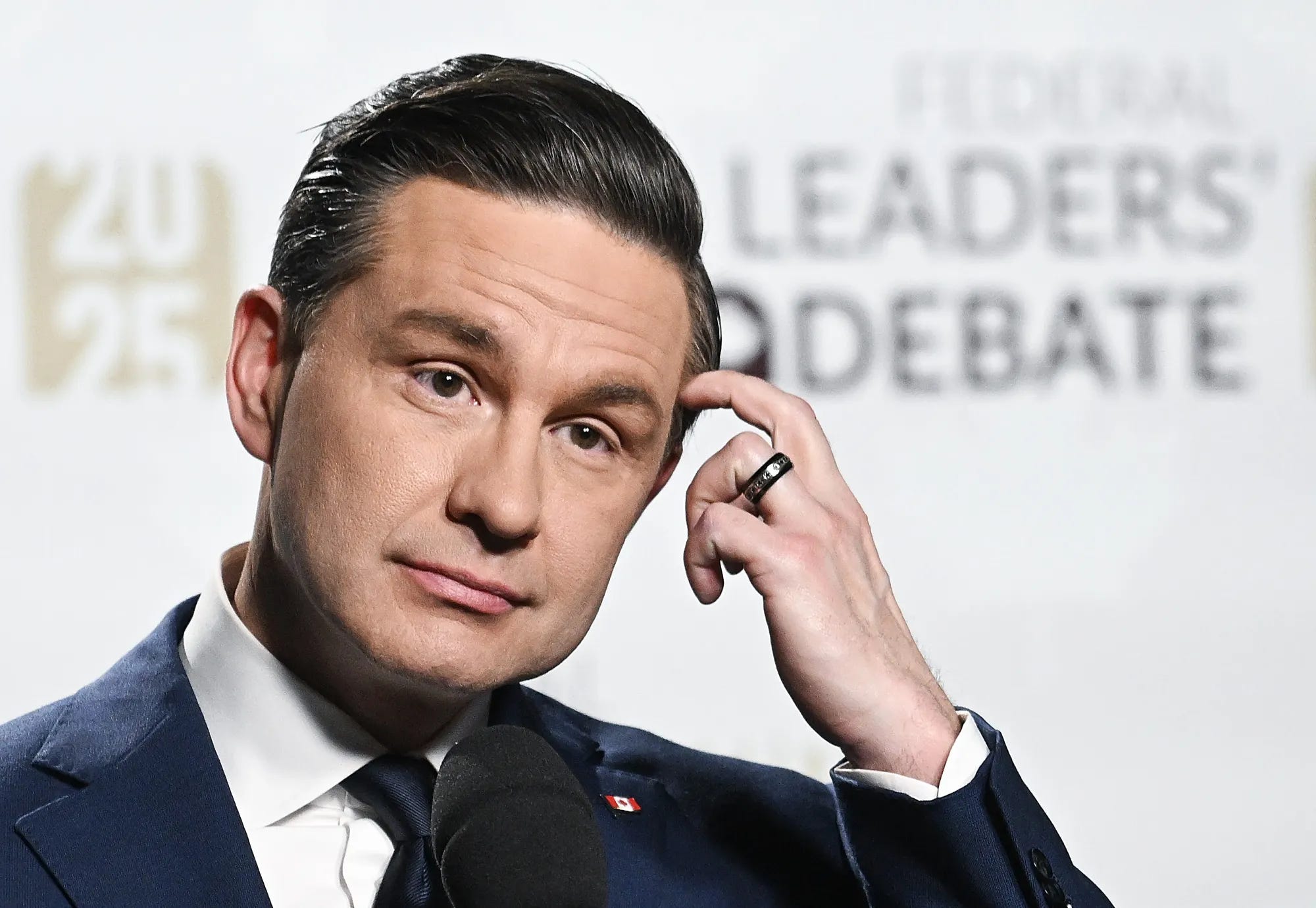
Former wonderkid, Pierre Poilievre entered Canda’s parliament in 2004 at the age of 25. Today, he leads the country’s Conservative Party - the official opposition.
When the federal election rolled around last year, Pierre was the favourite to win. The demise of Justin Trudeau had shatted the nation’s faith in the incumbent Liberal party, a series of scandals in the preceding years having hampered his reputation irrevocably. Calls for him to resign grew to a deafening roar. Voters were desperate for change. It looked like it might be Pierre.
It was as close to a sure thing as there is in politics. Until the inevitable happened. Donald Trump opened his mouth.
Returning to the White House, Trump floated the idea of adopting Canada as America’s 51st state. How serious he was is unclear, but it didn’t matter - Canadians didn’t want it, and they weren’t willing to entertain the risk.
So instead, Pierre leads the Opposition. America (naturally) dominates the geopolitical conversation, but we wanted to know: how are things looking in the Canada? What’s the view of the world from the great white north?
What did we talk about?
”Trump made it hard. We wanted to focus the issue on domestic issues, where we had a strong case, but the sound and fury of the American election made that impossible … We can’t control President Trump, so we should focus on the things we can.”
Trump’s pledge to occupy Canada made him - if he wasn’t before - extremely unpopular with Canadians. The election became an indictment on whichever party would flick his ear harder. According to Pierre, whether or not he meant it is unimportant.
”It’s never going to happen. And everybody knows it’s never going to happen.”
At the time, Pierre could only condemn the American President so much - after all, they’re on the same page on many of the major issues. The same is not true for the Liberal party. Mark Carney, Canada’s current PM, has advocated isolating their neighbour. Europe and Canada should focus on their alliance and leave America out in the cold. You can come in when you learn to play fair. He’s even gone as far as to suggest this alliance should, in place of America’s megalithic influence, cosy up to China. To Pierre, it’s an absurd and undesirable pipe dream.
”You can’t ignore China… but we can’t have a permanent rupture with our closest neighbour and biggest customer in favour of a strategic relationship and new world order with China. We need to have a solid friendship and security partnership with the United States - there’s no way China or anyone else will replace that.”
This is all important, but one can tell it’s not where Pierre’s core interests lie.
In a time of pervasive globalism, he advocates a return to domestic focus. At the end of the day, life in Canada is not what it ought to be. As bad as we think things are elsewhere in the West, there’s an argument that each of our issues are more pronounced there. Demoralisation, deindustrialisation, the rent economy, oppression of speech… it’s the same story again. Some of the stats are baffling.
”Of all the G7 countries, we have the fewest homes per capita. It’s insane; we have 10x more land per person than the 2nd most, which is America. We should be a dirt-cheap place to live. We have the most dirt!”
In Pierre’s estimation, none of this is an accident. It might be easier to take if it were typical run-of-the-mill incompetence and government short-sightedness. And no doubt there are elements of that too. Rather, there has been a systematic, deliberate extraction of wealth from one group to another. The costs are astronomic.
”For the last decade or two, we’ve seen a total betrayal of the working class. The people who move stuff, lift stuff, build stuff… Young people are entering the job market and are seeing their opportunities disappear, taken away by a small group of well-connected insiders. It’s caused immense political instability, as well as the rise in socialism and protectionism. Now is the time to push back - it’s time to give people control of their lives.”
But ’giving people control of their lives’ has not been Canada’s M.O. for some time.
A large factor in Trudeau’s resignation was the drastic loss of support he experienced in the wake of the Canada convoy protest. In case you missed it, in early 2022, a collection of Canadian truckers staged was a series of protests and blockades. Initially, these were organised to oppose the enrolment of COVID vaccine mandates for cross-border truck drivers, before expanding its scope of influence to all COVID restrictions.
The government’s response wasn’t to hear them out, or weigh up their concerns. It was to punish them.
The federal government invoked the Emergencies Act, granting extraordinary powers to law enforcement. Within a week, blockades and protests had been dismantled, and the government frozen the bank accounts of the convoy’s organisers.
The story rattled the conscience of liberal-minded people the world over. None more so than Pierre.
”The truckers were [just] looking to be heard. In the early days of COVID, they were heroes… driving along lonely highways for weeks, away from their families, bringing us the things we couldn’t live without. Then, when it came time for them to have their say, the government robbed them of their liberties.”
But why did it happen? Stereotypically, Canadians are viewed as gentle, passive people. Is there something about the Canadian psyche that brought it about? Something that allowed a government to dogwalk its people?
Pierre’s response is flat and unbending.
”No.
It was the government. Canadians love their freedoms. They love freedom of speech, free enterprise, freedom of movement … that’s why it’s been easy for me to stand by my principles.”
Perhaps we in our European glass house are in no place to judge. On our island and on the mainland, the same trends are mapping out - trends we feel powerless to stop. It’s hard to recall a time when a major European power became more free than it was before.
Even if the circumstances are different from those in Canada, the mechanisms are precisely the same.
”It all comes down to freedom or force. There’s a movement to concentrate power and control money. That has led to a huge gap between rich and poor. The solution is to give people back the power and shrink the size of government.”
Here, Konstantin challenges him…
