


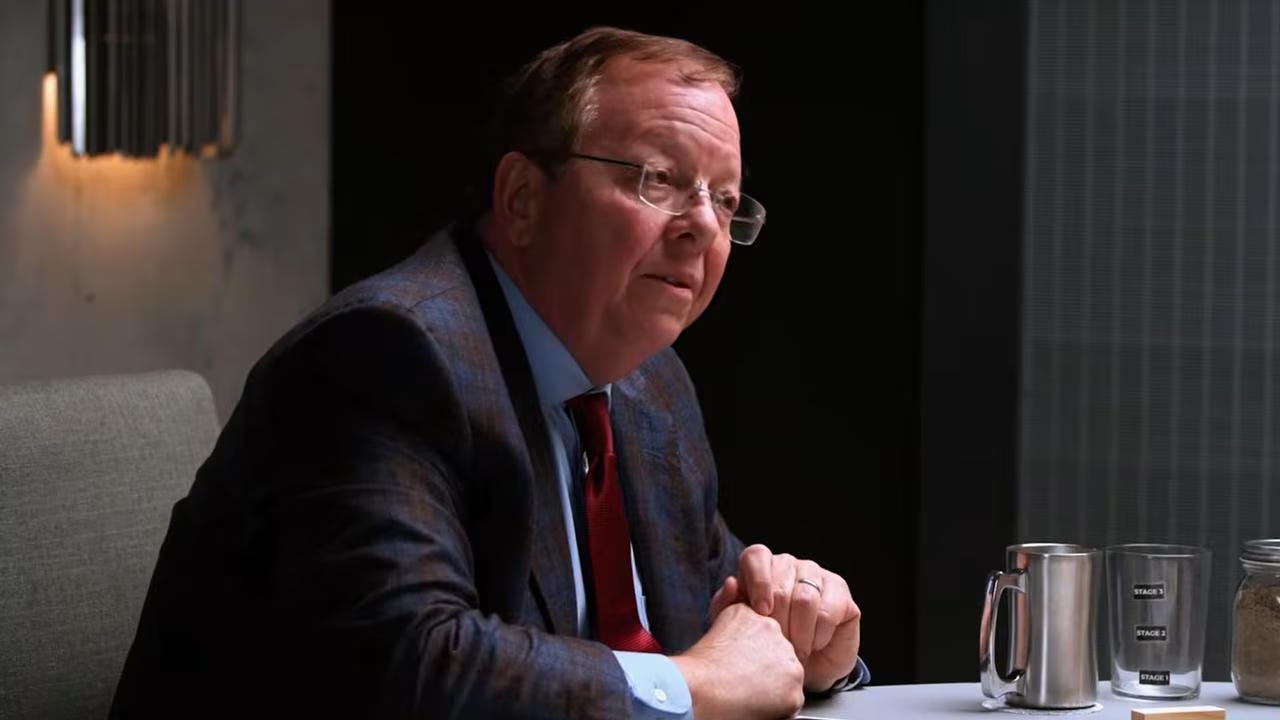
Professor Robert Pape is one of the most revered political scientists working today.
Previously, he has served as an advisor for the likes of Barack Obama and Ron Paul, and written three acclaimed books on the subjects of bombing campaigns and suicide terror tactics. Today, he is a tenured professor of political science at the University of Chicago, as well as founder and director of the Chicago Project on Threats and Security. He has also recently begun writing on Substack, which you can sign up for here.
Why did we invite him on?
”President Trump is facing two terrible choices. Terrible for the world, terrible for his presidency.”
This episode is the second in a run of interviews we’ll be releasing tackling the situation in Iran. In the first, published this past Sunday, we hosted Senator Ted Cruz, one of the policy’s most ardent supporters. In his mind, the war is a sure-fire win for America. Something that will be settled in a matter of months, ushering a new era of security and prosperity for the superpower.
Robert is not convinced.
What did we learn?
”My work is looking at the mechanics of things and how that intersects with politics … These strikes were inevitable.”
To the average person, or anyone without an interest in geopolitics, Iran won’t have been a cause for concern until last summer when Trump launched the Twelve Day War. It was the first time many of us had heard about the alleged threat the country posed to the West, and the first time the Western superpower had opted to strike them.
To everyone paying attention, it was the ultimate ticking time bomb. Whatever side of the debate you found yourself on, what happened in Iran mattered to you.
”In 2002, the relationship between America and Iran fundamentally changed. Before that, there were tensions, but in 2002 we discovered that Iran was going to enrich uranium.”
From the outset, Robert walks us through two decades of nuclear development in the Middle East and how it shaped the American response we’re seeing today. When did America start to panic? When did strikes become ‘inevitable’? What could have been done differently? Robert is equipped to answer all these complex questions with remarkable clarity of mind, and it makes for a hypnotic conversation.
Ultimately, only one question truly matters: is this going to work?
That depends. What do we mean by ‘work?’ Whether America achieves its stated aims is one thing, but whether those stated aims are desirable or in America’s long-term interests is another thing entirely. Understanding the difference between those two terms, Robert explains, is crucial.
”The regime change war is failing. Strategically, but not tactically. And we have to be super clear about that. Our bombs are hitting the targets over 90% of the time, our military is hyper-professional. It’s the strategy that’s failing.”
The tactics, according to our guest, are being executed superbly. Trouble is, they’re not having the desired effect. The oh-so-simple promises laid out by those in power have, so far, gone unfulfilled, even inverted. We shouldn’t be surprised.
”At this stage, the goals are to topple the regime and replace it with a better one. That’s not happening. Why not? It’s the pattern of history - it’s never happened before. When you kill the leaders, all the incentives are for the replacement leaders to come in more aggressive than before.”
Many pundits will insist to you that nobody wants this war more than Iran. It’s a claim not without evidence; one doesn’t need to look far for videos of demonstrators celebrating the death of the Ayatollah, heralding in a golden age of democracy and civil liberty. Unfortunately, it’s not an accurate or complete picture. Not all of those videos are actually from Iran. Rather, they depict the Iranian diaspora, much of which is scattered throughout the West. It creates a distorted image of how popular this attack is. In reality, this policy only guarantees one thing…
