


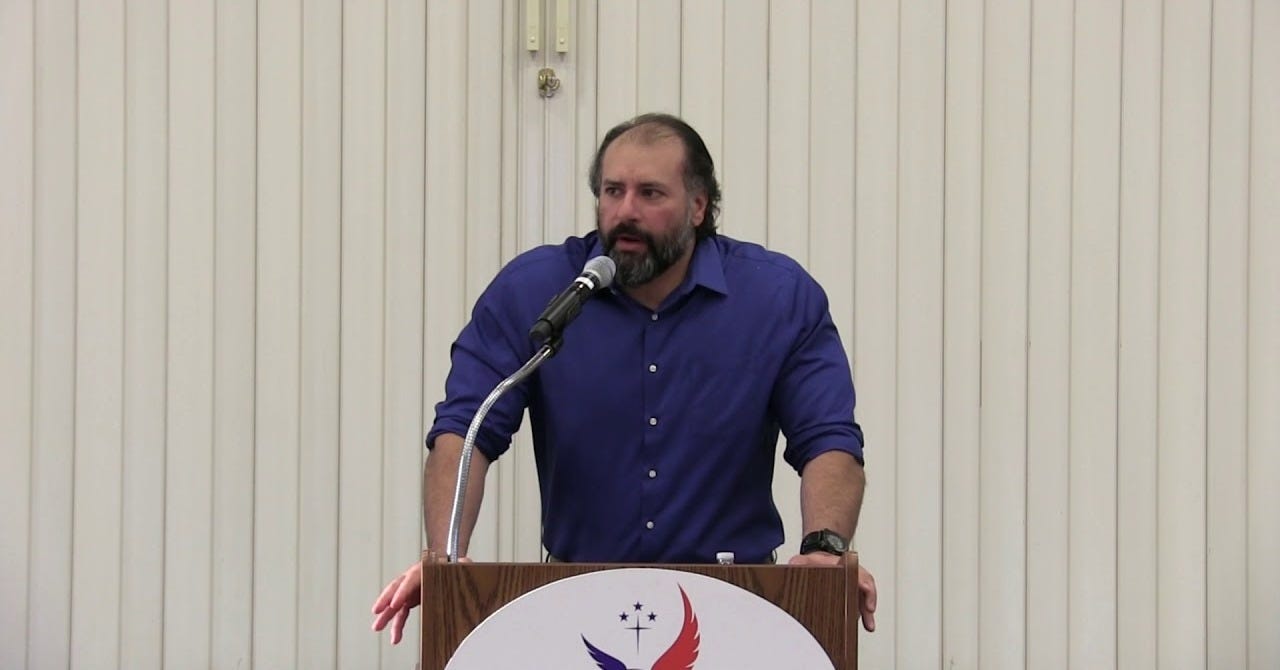
Raymond Ibrahim is one of the most outspoken and informed critics of Islam in the world today. In academia, he wrote his master’s thesis on The Battle of Yarmuk under Triggernometry regular Victor Davis Hanson, before completing his PhD in medieval Islamic history. He then worked as an Arabic translator for the Library of Congress. Today, he is the Distinguished Senior Shillman Fellow at the Gatestone Institute, as well as the Judith Friedman Rosen Writing Fellow at the Middle East Forum - each an Islam-critical think tank. As well as continuing to write - with published work in The Los Angeles Times, The New York Times and The Washington Post - his YouTube channel boasts over 110,000 subscribers.
Why did we invite him on?
Islam is the fastest-growing religion on Earth. Between 2010 and 2020 alone, the Muslim population increased by 347 million and surpassed 2 billion.
By mid-century, it may usurp Christianity as the most widely held faith on the planet.
Population growth in the Middle East doesn’t account for these numbers.
So, how did it happen?
Raymond possesses a forensic understanding of Arabic history, as well as a remarkable ability to eludicate the many complex stories that make it up. We wanted his perspective on why the trends are as they appear, what they say about the nature of the faith, and what they tell us about the future of the West.
What did we learn?
To get to the bottom, we must start at the top. Islam’s place in the world in the 21st century gives us no shortage of conversation, but it’s insufficient. As Raymond explains, its growth is no accident of fate. This outcome was inevitable. Only by going back to the very beginning can we understand why.
Raymond walks us through the genesis of Islam: the origin story of its prophet Muhammad, his humble beginnings, and his transition from peaceful collaborator to conquering warlord. Unlike the central figures of other major religions, Muhammad saw the rise of the faith in his lifetime and at his own hand. In doing so, he laid the groundwork for centuries of conquest.
”[By his death], Muhammad had secured almost the whole of Arabia. When he died, many of these tribes [he conquered] thought the jig was up and tried to go back to their old ways. But his successor continued to wage war on the apostates.”
This, Raymond argues, never went away. It’s overlooked, brushed under the carpet, but it explains a great deal. For starters: the crusades.
”[Under the oppression of Islamic powers] they can’t build churches. They can’t sing. They can’t show a crucifix anywhere. They can’t prostheletise. They can’t even do anything to prevent their friends and family from converting to Islam. If a Muslim is travelling and wants to enter your house, you have to let him.”
Christianity, pre-Enlightenment, has a reputation of barbarism - just as much, if not more so, than the jihadists that characterise the extremist wing of Islam today. Vivid stories of atrocity, subjugation, and violence pepper the history of Christendom. Its critics will often cite them as proof of a moral equivalence - Islam and Christianity are no more or less moral than each other. Is that fair? Raymond thinks not.
”You hear these crazy things about medieval Christians being so evil and intolerant. But there’s a background to that. The reason they became fanatical was because the [Islamic] tribes wouldn’t stop trying to kill them. At first, they allowed them to stay, on the condition that they converted. But Islam has taqiyya - you’re allowed to lie and deceive to further the Muslim cause. Many Muslims ‘converted’, but only so they could try and subvert Christian rule.”
What’s more, Islam’s historic reputation as a lost bastion of science, mathematics, and art is - in our guest’s view - a falsehood.
“There was a time when Islam was ‘liberal’, but only in spite of Islam itself. All the figures who made it appear liberal were either non-Muslims or forced converts; Islam shouldn’t get the credit for their work.”
From here, Raymond is able to guide us through nearly a thousand years of Arabic history. The Golden Ages, the battles, the crusades, the periods of prosperity, the eras of disquiet, and the struggles for power, all of it detailed in compelling resolution. We could share some of it with you now, but frankly, it’d be wrong - impossible even - to reduce it down any further than Raymond already has.
What we can share instead is Raymond’s insight into the current state of play.
Much has been made about the “Islamisation” of Europe. Whatever you think of it, it’s undeniable; the fraction of the continent that identifies as Muslim has grown exponentially in the last decade alone. And it shows no sign of stopping. Even if migration were to halt, this trend would not change; the Pew Research Center reported that “even if all migration into Europe were to immediately and permanently stop … the Muslim population of Europe still would be expected to rise from the current level of 4.9% [2016] to 7.4% by the year 2050.”
Is this an ‘accident’, or something else?
Yes, and yes again.
