


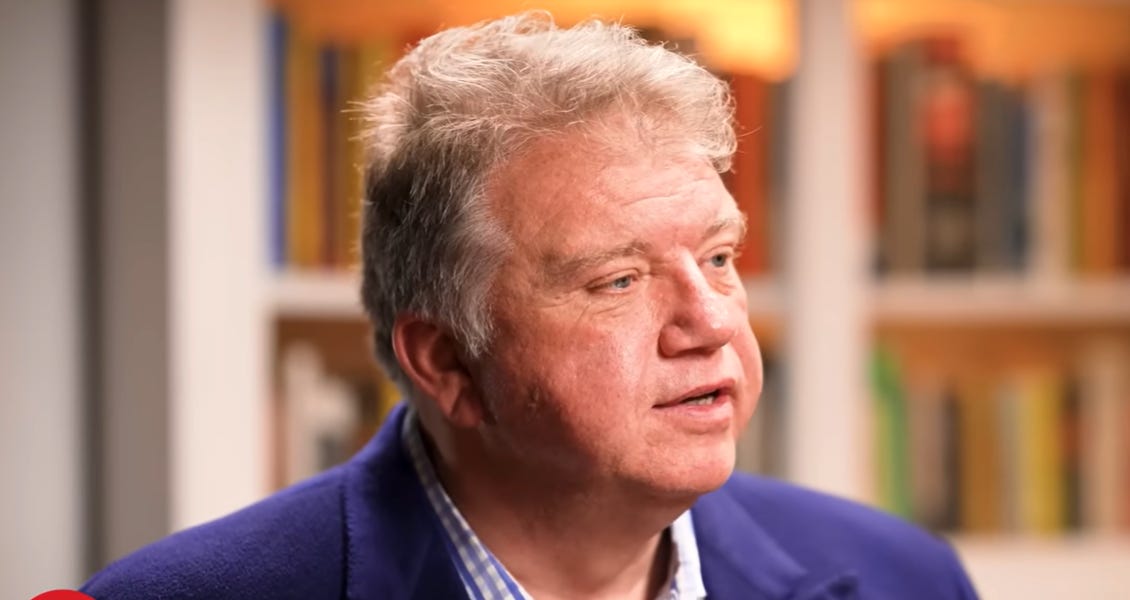
Richard Miniter is one of the most respected names in investigative journalism. His career spans several prestigious publications, having contributed to the likes of The New York Times, The Washington Post, The Wall Street Journal, The Atlantic Monthly, Newsweek, The New Republic, National Review, and Reader’s Digest, and his investigative work earning him accolades from the likes of the National Press Club and the International Consortium of Investigative Journalists. Today, Richard continues to provide insights on global security issues and writes best-selling books on geopolitics from a conservative perspective.
Why did we invite him on?
In May, Richard joined us for the first time, appearing in what has gone on to be one of our most popular and acclaimed interviews to date, where guided us through the most thorough, detail-rich analyses of America and its psyche that we’ve ever heard. For 80 minutes, we hardly said a word. As of the time of writing, that conversation is sitting at over 1.3 million views on YouTube. Even as we were wrapping up, we couldn’t wait to have him back.
This time, however, we wanted to explore something else. Something more personal to our guest. Namely, the world he’s committed his life to: the media.
Richard’s canon as a journalist is one of the most impressive of any alive today. Sadly, the field has gotten less competitive in recent years. Reporters have shaven off their objectivity, the incentives have mutated, and nobody knows what to believe.
Put bluntly, the media is broken.
That may be no revelation. After all, the popularity of new platforms like ours is itself an indictment on the public’s shattered trust.
Less clear, however, is how it happened. That’s what we wanted to find out, and we knew Richard would deliver a masterclass. Somehow, we underestimated him.
What did we learn?
In typical fashion, we can’t start there. First, we have to go back. All the way back. For the first half of the interview, Richard guided us through the entire history of ‘news’. Yes, really.
To the layman, the idea of ‘news’ being ‘invented’ might be perplexing. After all, for as long as there have been ‘events’, there will have been people to report and remark on them. In some ways, ‘the news’ is as ancient as cave paintings, as timeless as story-telling itself.
Richard draws the line in Ancient Rome, when the empire decided to take up the mantle of reporting war stories to its populus. It seems obvious now, but only in hindsight. What compelled them to do it?
”They were trying to control rumours and speculation. However bad the internet is, Ancient Rome was far worse. And they realised that if they didn’t do something, wild stories would abound. And that meant coups, trials, executions, all sorts of upheaval. They knew that if they gave the public a common vocabulary of facts, they could discuss, and decide what the best way forward was. They knew it would create a less polarised world.”
From here, it’s a wild ride through centuries of European history, with the narratives of journalism, infrastructure, imperialism, and war shaping one another throughout. Richard takes us from the advent of the printing press, to the importance of the Rhine, how Protestantism in Germany liberated speech for the first time, the peace it fostered, the creation of the newspaper and the capitalisation of trust, all arriving at how one court case set the precedent for English-speaking world to speak out against the corruption of its elites.
This is only the briefest of round-ups. It’s an incredible story, and one that may reignite your belief in the marvellous, dynamic institution of journalism. It took millennia to get there, but the promised land was found…
”By the end of the 19th century, we have something like an honest news system. We’re collecting stories from all over the world, there’s healthy competition, there’s accountability, and it’s independent. The papers were in competition, so you had to be good. Then two things happen.”
… before it was razed once more.
”The [powers that be] realised that if they controlled the means of production, they could control the production. So first, starting in 1908, there’s a campaign to unionise journalists. Now, journalists don’t like unions, so they refuse. But [newspapers’ offices] are bombed in response, the attackers are linked to the unions and it makes worldwide news. By 1933, the first major newspaper is unionised, and by the early ‘60s, all radio, television and newspapers are under the same unions. That’s a cartel. That’s not good for dissent.”
It took aeons to get there, and in mere decades it was over.
The first order effects of this shift were bad enough. Suddenly, newspapers were controlled in what they could and couldn’t report on. the stories they were and were not permitted to break. Anything that was damaging to the unions and their interests would be smothered. Already, the purpose of journalism had been inverted.
It was no longer there to expose. It was there to control.
The second order results were somehow more damaging…
