


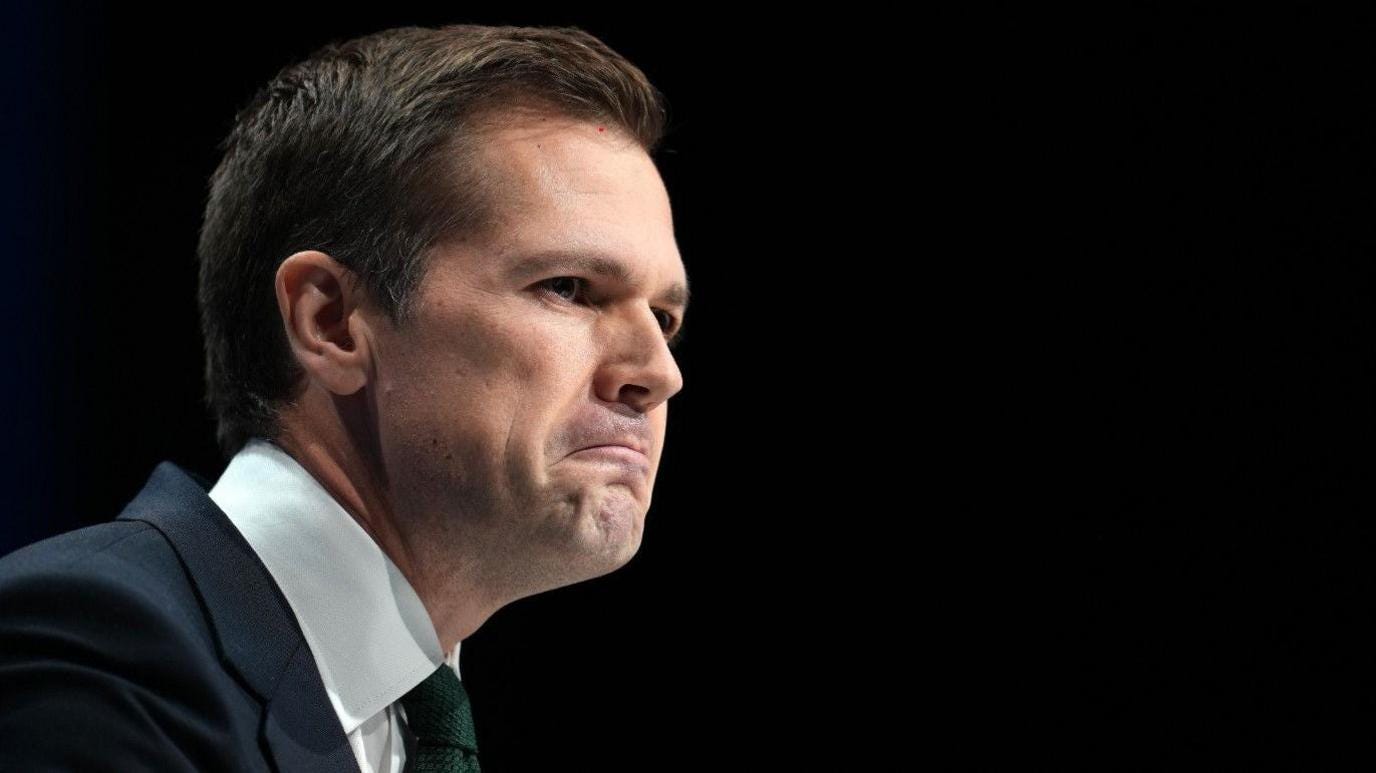
Robert Jenrick is one of the most tenacious names in British politics today.
When the Conservative Party lost their majority to Labour in the 2024 election, Robert vied for the position of its leader. Ultimately, the role would go to Kemi Badenoch, who enlisted him into her cabinet.
But Robert didn’t retreat into the shadows. While others in his position might have opted for a quiet life of technocracy, Robert took to the internet with a series of vigilante man-on-the-street videos. With these, he planned to expose the lived reality of Britons; the most widely-seen focusing on the extent of fare-theft on London’s tube system. The clips went viral, and Robert Jenrick became a household name.
Two weeks ago, Kemi fired him, accusing him of deliberately subverting the party and of scheming to defect. Later that day, Robert did exactly that, joining the fastest-rising political party in Britain: Reform.
Why did we invite him on?
Robert’s defection has raised questions and eyebrows across the British political mediasphere. Competing theories have swarmed in the days since, some more charitable than others.
Is he cynical? Is he sincere? If he is, what took so long?
We were curious too, and we wanted to give Robert a chance to address those questions for you.
What did we talk about?
”Looking back, we can see the roots of our current problems, but it didn’t feel like that at the time. It was possible to believe the state basically worked, that things weren’t going in completely the wrong direction. But in the last few years, it’s been impossible to feel that way. The country’s in a real mess. It’s going in the wrong direction, and the people I want to represent are finding life difficult because they were let down by a generation of politicians who made a series of bad calls and lied to them.”
When we have politicians on, we always try to reach the person behind the podium. It’s easy to put on a performance for 10 minutes with a pre-written speech and pre-ordained clarifying questions. It’s also easy to see them as nothing more than that. MPs are people, and we want to know who they are.
”My parents gave me the values that drove me into politics: hard work, small business, love of country, belief in the family as the foundation of all.”
These principles, in 2026, are commonly associated with the right. But Robert’s upbringing wasn’t conservative; his parents were working-class Labour voters. His wasn’t a life of croquet and shooting and polo.
The fact that these have been handed over to the right says a great deal about how our political framework has crumbled in the last decade.
”In the past, our values seemed pretty constant. The things that I’ve talked about in recent years, many of which have been labelled right-wing or, even worse, ‘extreme right’, which is complete nonsense… These were things we once took for granted. You shouldn’t have open borders, you have to keep regulations low, you need to make sure the workers are compensated… These are still the views of most people in the country, but our political and media elites have become completely detached.”
Getting his start when he did, Robert’s entire political career has been under a period of political revolution. The country today could not have been imagined by the average voter 10 years ago, and Robert had to navigate those waters without the benefit of preceding experience. It’s been a challenge, but also a trial-by-fire, through which he’s managed to earn political experience beyond the years he’s been afforded.
”I’ve been elected 5 times, there’s been a referendum, I’ve served under 5 Prime Ministers. A generation before, you’d need a career of 40-50 years to have a resume like that. And the politics of the country have changed, even compared to 2015.”
More recently, Robert’s instigated that upheaval in his career himself. After 10 years serving the Tories, Robert made the “gradual, then sudden” decision to defect to its biggest rival: Reform. Why?
”Reform is the one party that recognises that our country is in real peril. [The Conservatives] are conflicted.”
Cynics and sceptics may, quite fairly, side-eye Robert for this switch. After all, he served the Conservative government that created so many of the problems that Reform are capitalising on. He was a party member - and a significant one - through the period during which they made most of their most damaging decisions. Now, he’s joined the enemy.
How did that happen?
