


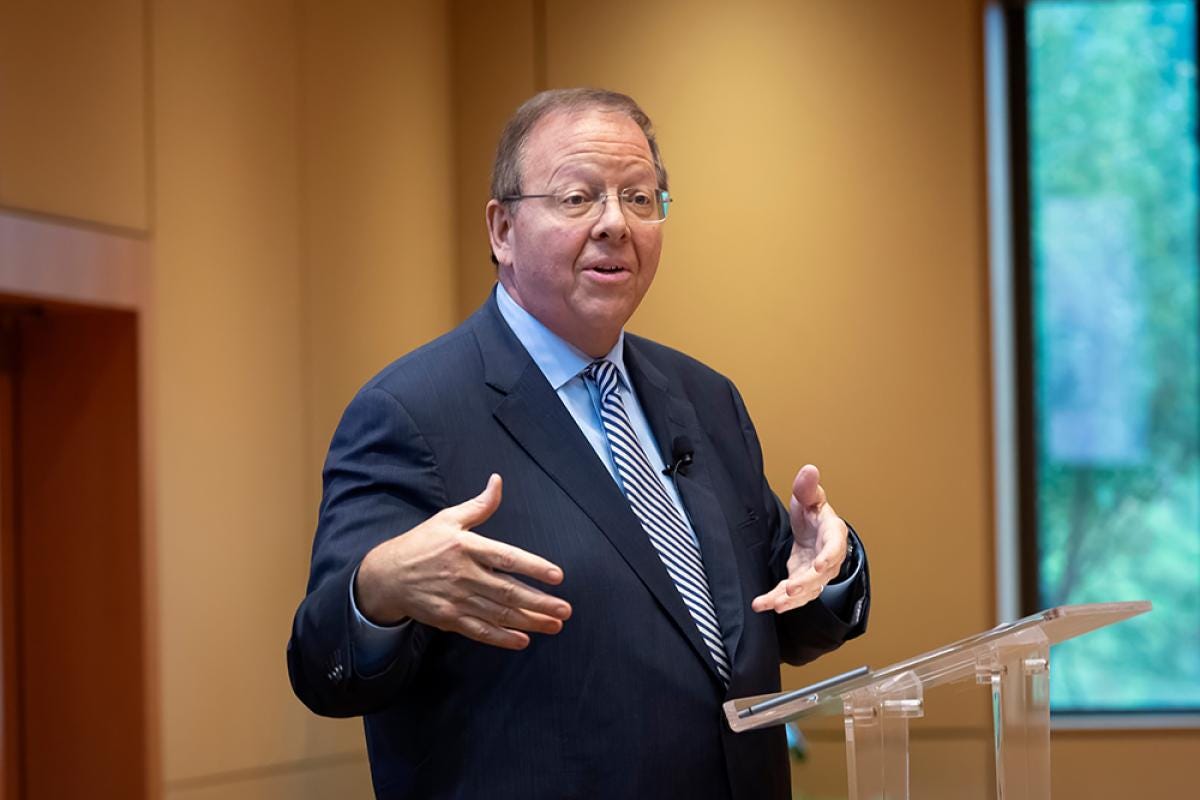
Professor Robert Pape is one of the most revered political scientists working today.
Previously, he served as an advisor to the likes of Barack Obama and Ron Paul, and has written three acclaimed books on the subjects of bombing campaigns and suicide terror tactics. Today, he is a tenured professor of political science at the University of Chicago, as well as founder and director of the Chicago Project on Threats and Security. He has also recently begun writing on Substack, which you can sign up for here.
Why did we invite him on?
Robert joined us in March this year, weeks into the Iran war. In what proved to be a viral exchange, as well as one of our favourite interviews to date, the professor laid out his ‘Escalation Trap’ -a roadmap which explains how conflicts can go from minor skirmishes to globe-threatening clashes without any irrational moves.
Seven months on, the war continues. With midterms fast approaching, it might just prove to be the most significant factor shaping the next few years of American politics.
We wanted to know: what does Robert make of the situation? Where does he see America going? What were the mistakes made along the way? Who’s to blame?
What did we learn?
”We should have seen this disaster coming.”
Robert’s escalation trip has no timeline. Rather, it’s a sequence of predictable stages that a war can find itself dancing through with ease. It’s “only” been 8 months since Trump declared war on Iran; where does America find itself now?
”This is probably the most wicked escalation trap in modern history. It’s not just about the political consequences for the leader who started, or the consequences to that leader’s society. This is having worldwide economic consequences that are truly devastating. We all hope they don’t get worse, but we’re on a trajectory where they will continue to get worse, and worse, worse.”
So, using the professor’s model, how far along is America now? There’s no set time that a country can and will spend at any one plateau, but it’d help to get a gauge of how much and how quickly things have escalated.
Robert suggests we’re looking at it wrong; it isn’t the American’s view we should be adopting.
”We’ve already gone through several stages, and they’re best understood from the perspective of Iran … The big thing they learned at the beginning of the war was that they’d survive. They didn’t know that before this war; they might have believed it, but they didn’t know it. Now they do, and that’s given them power. Now the bargaining is happening on their terms.”
Pundits have been floating their theories on how this war could be swiftly brought to a close. Some suggest elevating the degree of attack; others suggest cutting the losses and walking away now. Konstantin suggests a more pragmatic, middle way.
Iran’s blockage of the Strait of Hormusz has already proved to be an effective tactic, and one could the US could emulate by also blocking the Straight. The world economy is so much greater than Iran’s, and Iran is so dependent on exporting to it - isn’t it just a matter of strangling the flow of commerce until they beg for air?
”If this was a business deal, that would be exactly the way to approach it … I’ve talked to many folks in business about this because they make deals all the time. They don’t understand that there’s no incentive for Iran … But there’s no way of enforcing the deal on behalf of the weaker side of a dispute in international politics.”
We throw a few more policy suggestions at Robert - none ours, but ones that have been floating around in the commentary world for months - and he coherently explains why each is insufficient or inappropriate for this set of circumstances.
How did we end up here? How could America not know what they were facing?
”We’ve been working with a model of war that is 35 years out of date.”
And what model is that?
