


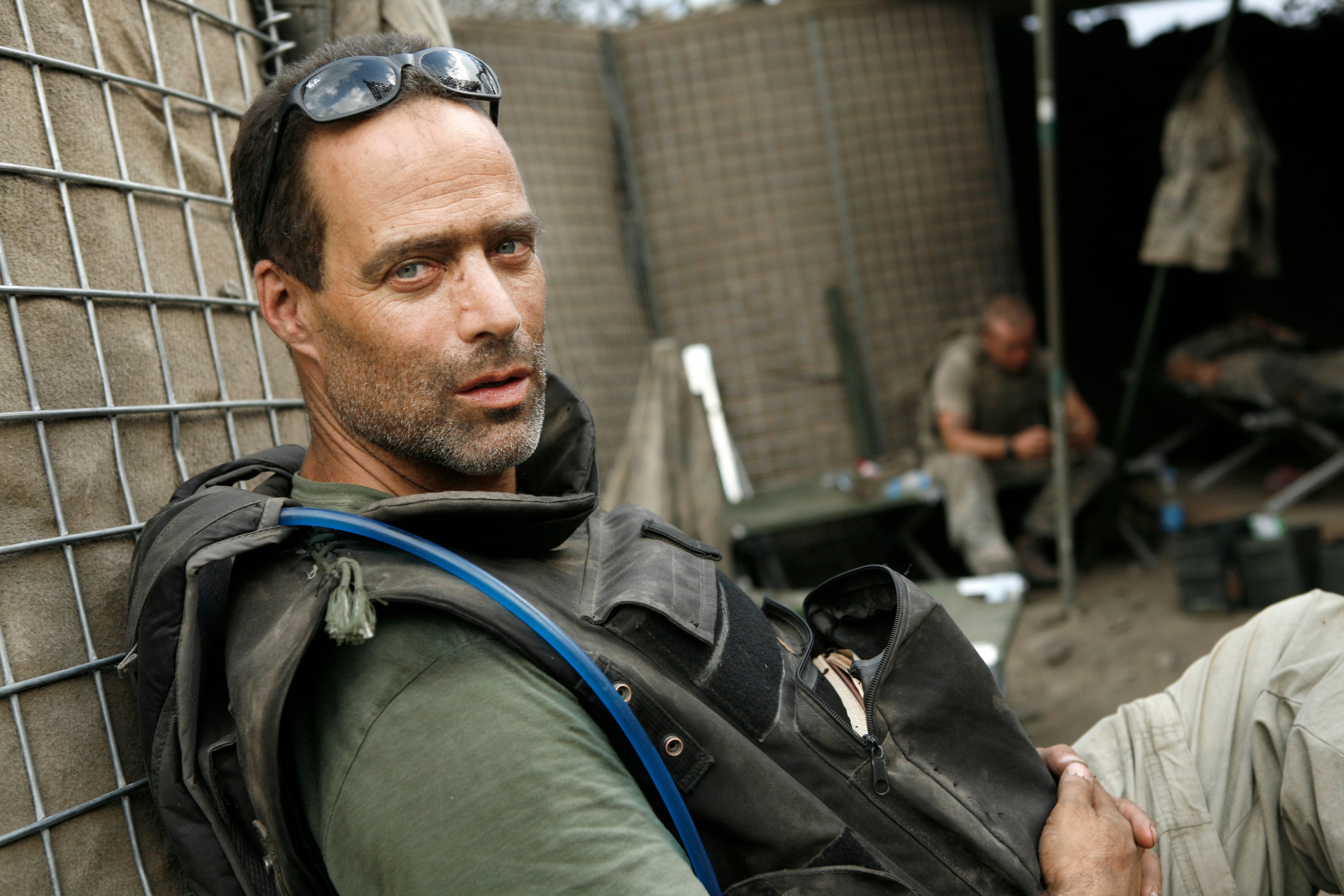
At a time where many of his peers prefer to sit in air-conditioned offices and prospect on the world, Sebastian Junger is unafraid to see it himself. For that, he is one of America’s bravest journalists.
He came to prominence in 1997 with the release of his creative-nonfiction masterwork The Perfect Storm, a genre-reviving book that was later adapted into a major motion picture. Later, he embedded himself in dangerous and remote military outposts across Afghanistan to report on the war, recounting his decade at the heart of the conflict in 2010’s War.
That same year, Sebastian co-directed his first documentary - the Grand Jury Prize-winning and Oscar-nominated Restropo, following it up with the likes of The Last Patrol, Hell On Earth and Against All Enemies.
His latest book - 2024’s In My Time Of Dying - details Sebastian’s near-death experience, as well as his ensuing reckoning with the prospect of an afterlife.
What did we learn?
”Our neurological wiring is from the Stone Age. We have not changed at all in 20,000 years. We are wired for living in groups of up to 100, hunting, building shelter, and being totally interdependent. We need to be useful to one another. That’s where we get our meaning. Modern society hasn’t changed that.”
A common thread through Sebastian’s repertoire is an interest in group strength. Teams of people, pooling their skills and resources, to overcome an unprecedented challenge.
These cases make for fascinating stories, but the phenomenon is not unique. Humans do it everyday. At least, we used to. Today, in atomised modernity, individualism runs rampant. Our needs are met with an ease that our distant ancestors - or even recent ones - could not fathom. We no longer turn to our neighbours for help. It sounds liberating. As Sebastian explains, it is not. Rather, it makes us depressed.
”Nobody commits suicide in Afghanistan. Some do when they come back, but one theory is that it’s the loss of community. It’s not the trauma … When you’re there, with people you’d die for and people who would die for you, even if you don’t like each other, that’s immense security. We have nothing like that here.”
Without wanting to brush over the obvious downsides of being stranded in a warzone, it’s clear that there’s something to the experience that bonds people. Why is that?
Evolutionary psychology, as a field, typically relates human thinking to the same incentives that drive all animal behaviour - ones of survival. This, Sebastian suggests, is where we differ most from animals. The way human beings react to that kind of stress is not merely an evolutionary quirk; it’s one that no other animal shares. We avoid it at our peril.
”We are the only species that will die to protect a same-sex peer. Not a child, not a mate, not a parent - another young man will give his life to protect another young man. We’re the only ones who do that, and that’s what makes us human. You owe your survival to the group and, therefore, you have a duty to them. That’s the essence of being human.”
Contrasting his experiences in desert foxholes with the exponential fractioning of modern life, Sebastian sees a huge discrepancy between what we think is good for us and what is actually good for us. Quite often, the material solutions to our problems have a spiritual side effect.
”A study found that the average American home has doubled in size in my lifetime, and there’s a correlation between people living in larger spaces and becoming depressed. It’s the tragedy of affluence; it has allowed us to live far apart from one another, and that’s made us depressed. The consequences, particularly for children, are terrifying.”
With the way things are going, it’s a strain to imagine the circumstances improving. In fact, they might get much, much worse, very, very soon.
AI is, for several reasons, a cause of grave concern. One such reason is what it will mean for the role of humans. If all of our needs and demands can be met by unthinking machines, faster than any team of people could manage, what will become of us then?
