


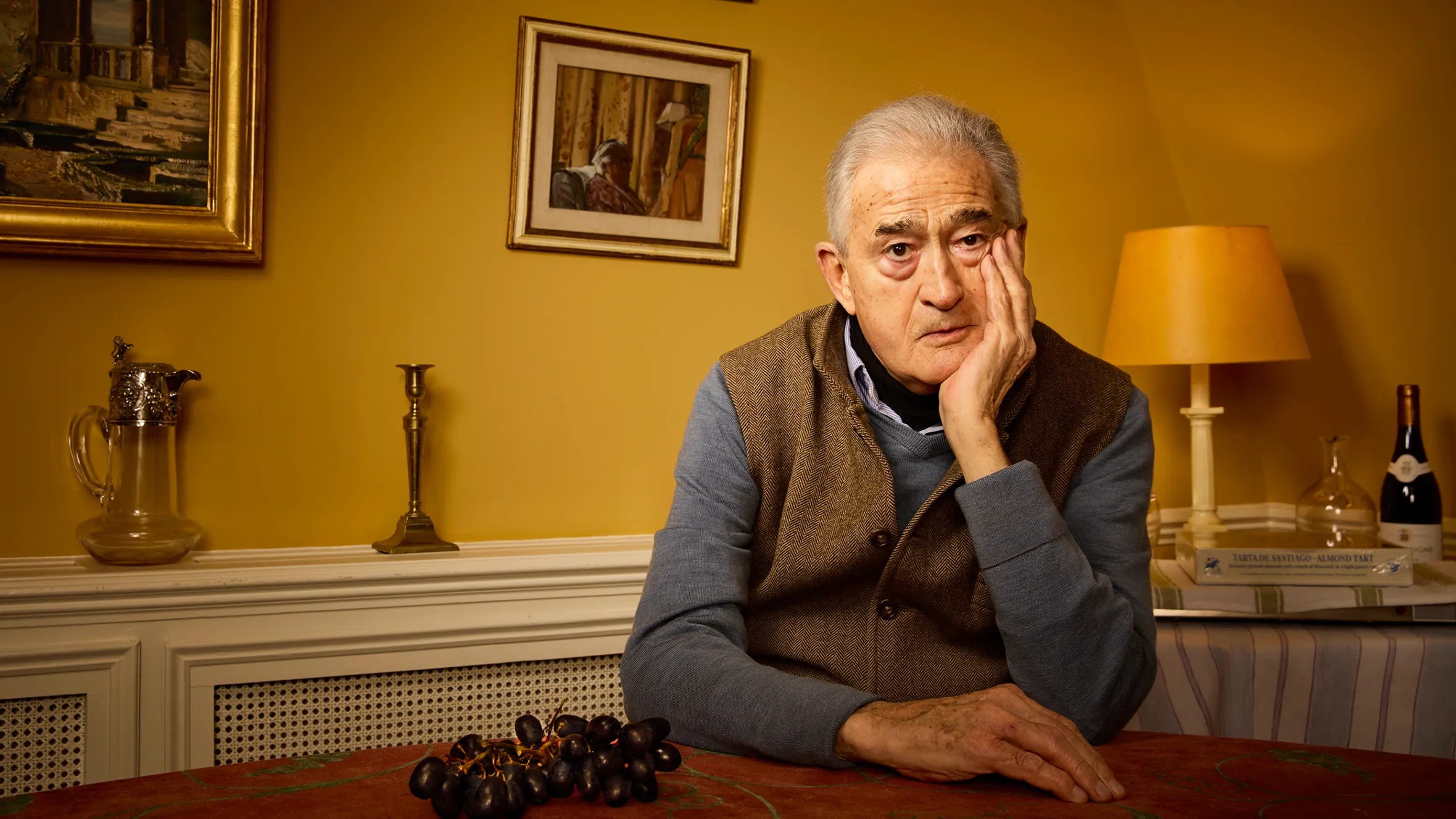
Sir Antony Beevor is one of Britain’s most revered and widely-read historians.
For over four decades, he has been publishing works of staggering depth, including the genre-defining Stalingrad (1998), the polarising Berlin (‘02) and 2012’s 900-page sprawl The Second World War. To date, his total sales amount to nearly ten million copies.
His latest tome, Rasputin: And The Downfall of the Romanovs, was released in March.
Why did we invite him on?
As long-time fans of Sir Antony’s work, perhaps this was no surprise, but earlier this year we read Rasputin and loved it. Across its near-400 pages, Beevor charts a path through Rasputin’s entire life, weaving its narrative with that of Tsar Nicholas II, the Tsar who abdicated during the Russian Revolution. It’s one of the most information-dense history books we’ve enjoyed in recent times, and we each knew it was time to have him back.
We wanted to discuss the life of Rasputin, but primarily, we wanted to use it as a backdrop for the wider subject of Russia itself, particularly the mindset of its people.
Russia has a distinct national character, one that persists despite the radically changing circumstances its people have enjoyed and endured. Its unique disposition is shared by citizens 5000 miles apart, in the Siberian tundra as well as on the Southwestern Caspian coasts.
But why? What is it about this country that is so unusual?
What did we learn?
To set the stage for our conversation, Beevor pulls a quote from 1866 poem by the Russian diplomat and poet Fyodor Tyutchev: “Russian can not be known by the mind [alone].”
”There’s a lot of truth in that. All these contrasting elements… In the case of Rasputin, we see deep spiritualitity mixed in with lasciviousness… or corruption mixed in with incredible generosity. All of these coming together in the same person… [he captured] the Russian soul. There is no [such thing as] national DNA, but there is a certain self-image in all countries that they try to live up to. A certain reputation, a certain tradition.”
And what is that reputation?
The Russian tradition is a complex one and, as Antony outlines, one of paradox. One feature commonly associated with the Russo mindset is callousness. Unfeeling, unsentimental, self-regulating to a hellish extent. Where does that come from?
Beevor asserts there’s a relationship between the attitude of Russians to life and their approach to war.
”There’s been a considerable debate among historians as to where the Russian method of warfare originated. Some say it goes back to the Mongol invasion of the 13th invasion … [They] believed that fire, sword, laying waste and mass rape were natural elements of warfare. And these became central elements in the Russian understanding of war: conspicuous cruelty.”
For the vast majority of history, ‘conspicuous cruelty’ was not unique to Russia. It was the norm internationally. Enemies were not there to be stopped, but vanquished. When the West moved on, Russia did not.
”[For most of history], Europe was just as bad! One thinks of the horrors of the wars of religion and they’re just as cruel as anything Russia had done up to then. The difference came with the Enlightenment. There was then a codification of war - not necessarily more civilised, but more rule-based.”
This is a peculiar history. One hard to map onto our own. The Mongols, through their successor state known as the Golden Horde, ruled Russia for over two centuries, from 1240 to 1480. That’s over two centuries subjugated by what Konstantin likens to “the ISIS of their time.”
