


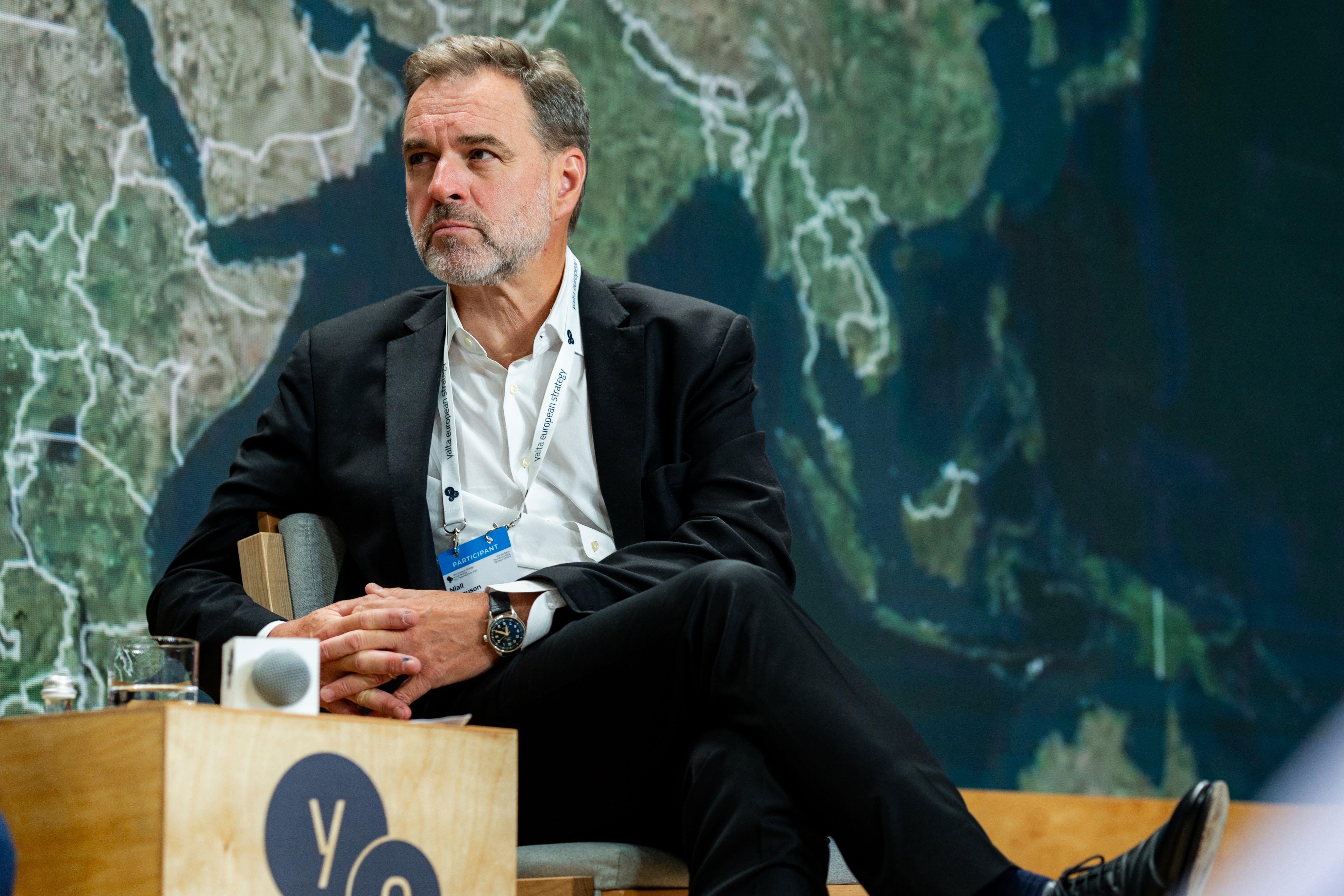
Sir Niall Ferguson is one of the most decorated historians alive today, and one of our favourites. He has taught at several of the most prestigious universities on the planet - from the London School of Economics to Oxford - and is a senior fellow at both the Hoover Institution and Harvard University. In 2024, he was knighted by King Charles III for services to literature. He is also the co-founder of the University Of Austin.
Why did we invite him on?
We’ve hosted Niall twice before. First, to dissect the factors that determine civilisational collapse, and then again last year to discuss Tucker Carlson’s then-recent platforming of Darryl Cooper and other ‘dissenting’ amateur historians.
Each was a highlight of its respective year; we couldn’t wait to host him again.
This time, however, we wanted to explore another one of Niall’s areas of expertise: economic history.
Much is being made of Britain’s incoming/ongoing financial crisis, and panic is beginning to set in. Its citizens are becoming acutely aware of their declining living standard, and yet they seem to pay more and more tax. Common sense tells us it shouldn’t be possible. What’s happening?
The truth is: this is nothing new. We are arriving at the inevitable endgame of decades, perhaps a century, of poor economic policy. Why? How can we fix it?
With Niall’s staggering historical knowledge, we wanted to know: did he see it coming?
What did we learn?
”Money is an ancient thing. We’ve found IOUs carved into clay from Mesopotamia … It captures the beginning of civilisations; it’s trust inscribed.”
Money isn’t everything, but it is everpresent. All decisions, big and small, that we make as individuals, families and societies are informed, shaped, and defined by costs and benefits. Money is the ultimate expression of that. What’s remarkable is, as we learn from Niall, it’s somehow even more fundamental than that.
Niall sets the stage by giving us a crash course through the history of currency. From the dawn of exchange, to the use of precious metals, to how the search for gold drove exploration around the world, the advent of interest and debt and how these transformed civilisations, the influence of the Rothschilds and why they’re so suspected, and how the crown - once it learned it could borrow from its people - blew wide open its ability to dominate the planet, changing the scope of finance forever. It’s a fascinating, breakneck tale, told by one of the greats.
But, that phrase: “trust inscribed”. It raises a question.
What happens to money in a low-trust society?
If the people no longer believe that their IOUs will be fulfilled, then what?
It turns out, things can go very, very badly wrong. We don’t even have to look back that far to see how. Case in point: the financial crisis. Many were shocked by the precipitous, devastating collapse of the world’s financial heavyweights, not least those worst affected.
Niall saw it coming.
”In 2006, there were a couple of red lights flashing on the dashboard, and I wrote about it at the time. There was a lot of debt in the financial system. Household debt, loans taken by low-income families, debt on bank balance sheets … And the cost of debt was rising. This produced a steady and sustained squeeze on any vulnerable borrowers.”
All things are obvious in hindsight, but even up to two years before disaster, there were signs. Suggestions that something terrible was afoot. Things might have gone another way, but, as Niall shares, there came a time where it could not be reversed.
”The moment of truth for me was when one of my friend sat me down with his mortgage specialist. She showed me a chart of when the sub-prime mortgages would reset. This was when the payments on these mortgages - which were initially low, and artificially so - would ‘reset’ to a market rate. And all of them were pro-programmed to happen in ‘07. So you knew it would start then, and then spill over in 2008.”
But if Niall and his fellow economists could see it coming, if all the signs were there, why was nothing done? Almost nobody benefitted from the financial crisis, and even those who did would never recover their reputations. Why didn’t somebody act?
”If the music’s still playing, you don’t stop dancing.”
Sometimes things must become terrible to never become so terrible again. “Never again” is a cultural meme that follows devastation of any kind. Thankfully, it’s largely true. New and terrifying things will inevitably happen, but do the precisely the same terrible things recur? Not often. For Niall, an economic historian, it’s unlikely we’ll face something like the financial crisis of ‘08 again in our lifetimes.
”There hasn’t been much volatility in the economy, at least by the standards of the 20th century. There are some parallels between the 1920s and the 2020s - traders who buy stocks on the ‘YOLO principle’, and thinkers with radical economic ideas. So the likelihood of there being another crash like 1929 in 2029… it’s very low. The Great Depression happened because everything that could go wrong went wrong, and there’s little reason to think it’d happen again. I don’t doubt that one day I will be back here talking about the next financial mess, but I don’t think it’ll be the same kind of economic pain of the 1930s.”
So, that’s that settled. Lesson learned, slap on the wrist, we won’t do it again.
No reason to worry. Right?
Wrong.
