


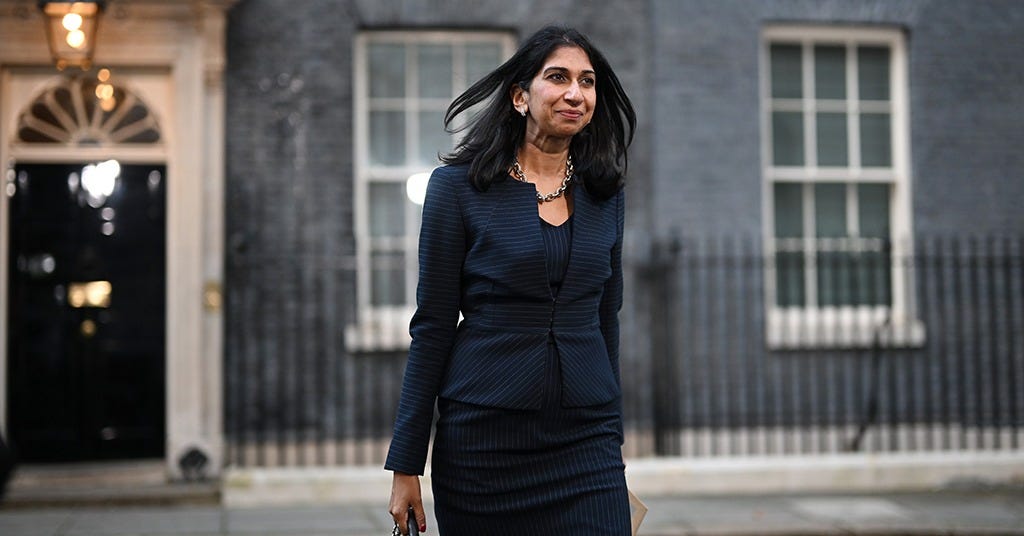
Under Boris Johnson, she was appointed Attorney General, in a role that took on special significance a month later when the UK government was forced to respond to the COVID crisis.
In September 2022, she was selected by Liz Truss to serve as Home Secretary, a position she held (with the exception of 6 days the following month) until November 2023, also managing the role under Truss’ successor, Rishi Sunak.
In January of this year, after 23 years serving the Conservatives, she defected to Reform. In October, she is due to release her memoir: Patriot.
Why did we invite her on?
Suella joined us in February 2024 to raise the alarm over illegal border crossings in the Channel. Then, the Conservatives were in power, and she was a member. Today, Labour are two years into their tenure; the Conservatives are scrambling for relevance, as Reform are readying themselves to challenge that status quo. Much has changed.
Much has not.
While some of the issues we discussed in our last conversation have shown signs of recovery, others have gotten markedly worse, with no sign of things being turned around soon.
With her new book on the horizon and a new party to serve, we wanted to catch up and see where she stands now. How does she feel about Britain’s future? What does she make of the British right’s skirmish for power? Whoever takes the reins, how will they reconcile these warring factions?
What did we learn?
Something which seemingly hasn’t changed in the time between now and Suella’s last appearance is the ongoing small boats crisis. It’s a subject Suella has been sounding the alarm on for a decade. Labour has talked big about fixing it, but have they?
”The dinghies are getting bigger, the numbers are still high, and the threat is coming closer to home. People are scared and angry, and I am too.”
If thousands were illegally crossing the border at any other time in history, we would expect the state to intervene. One could argue it’s their most central and legitimate role. This would be uncontroversial. What’s the holdup?
”There is no will. I was pushing it, but I kept coming up against Prime Ministers who didn’t want to do it. It was all a performance; all talking tough, but actually behind the scenes, behind closed doors, wholly lacking the requisite will to do the right thing legally, politically and diplomatically.”
A couple of weeks ago, we had Dan Hodges, a longtime Labour-supporting columnist on the show. While sharing a number of Suella’s beliefs regarding the state of illegal immigration, he dismissed the idea that it was so easily solvable. It’s not a matter of will. It’s a matter of ability. And an easy fix is not possible.
Suella disagrees.
”He’s wrong. It can be stopped. It has been stopped in other countries. This was what I was banging my head against under Johnson, Truss and Sunak.”
What can we learn from other countries? What steps do we need to take to fix this issue?
As Suella explains, it won’t happen passively. Nothing changes without decisive political moves that might be unpopular or may have troubling optics. It doesn’t mean they’re not necessary. Until one thing changes, nothing will.
”We need to leave the European Convention on Human Rights. I saw it before I was Home Secretary, and even before I was Attorney General; the ECHR’s laws have been weaponised against the British people. Whenever an enforcer wants to deport an illegal immigrant, they are met with an infinity of legal claims, many of which are illegitimate. The claimants assert that because they’ll be tortured in the country they’ll be sent to, we are violating their human right against torture. And the claimant could easily be lying; if they have ill intentions in Britain, they certainly will. And if you try to split up a family, we’re ‘violating their right to a family life’.”
’Leaving the ECHR’ is often framed by left-wing media as a self-evident evil. Without it, how can we guarantee our human rights are protected? What will the government be capable of?
This, Suella asserts, is a fallacy. The ECHR is deployed in ways which nobody would defend, but when criticised, it retreats to its much more agreeable position of ‘human rights protection’. Reading the charter, it’s hard to find anything to argue with. As it’s applied, it quickly becomes a problem.
”I don’t disagree with those laws. I agree with those rights. But they have been distorted and stretched; the ECHR is now a charter for illegal migrants, not a protection of human dignity, fairness or common sense.”
So, why is it so controversial?
”It’s the same arguments against Brexit. ‘It’d be bad for our reputation’, ‘We’d be in the same group as Russia.’ These are red herring arguments - all eminently rebuttable, but parroted by the “remainer wets” and “establishment liberals” who make up the bulk of the Conservative Party. Which is why I left.”
Suddenly, we find ourselves behind the scenes. Suella only formerly defected this year, but her conflicts with the Conservative Party can be traced by to 2023, when she publicly fell out with Rishi Sunak, then Britain’s Prime Minister. Konstantin had his own ding-dong with the former PM last week, in his case, on the subject of ‘Englishness’. Where does Suella stand on her former boss now?
