


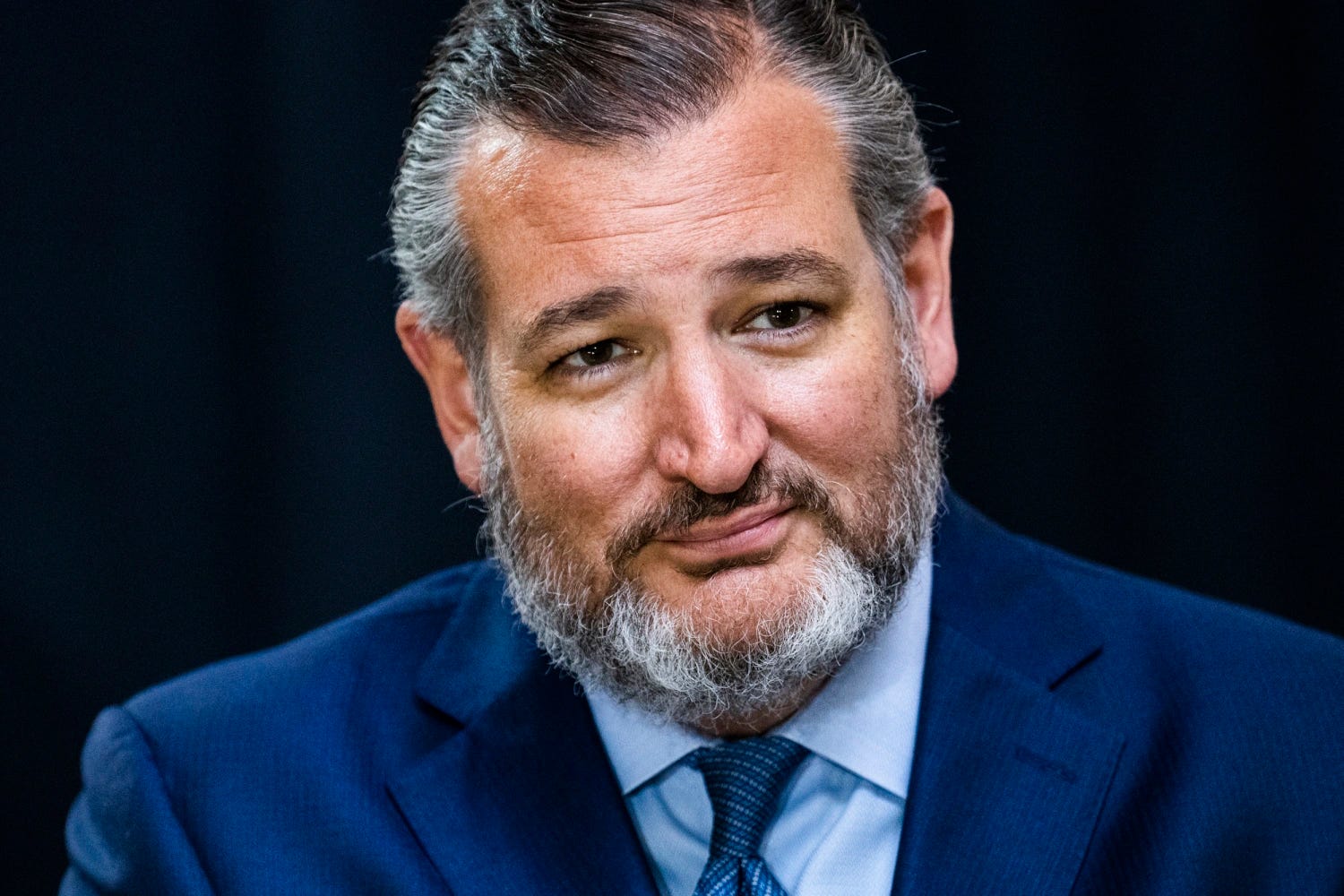
”When I was a kid, I would sit at my father’s feet and hear the stories of freedom fighters. It’s all I’ve ever wanted to do.”
Loved, hated, never ignored: Ted Cruz is one of America’s most divisive senators.
After several years in Texas office, he made his name internationally in 2016 as he competed for the Republican Party nomination ahead of that year’s general election. Trump would ultimately secure both, but Ted never retreated to the shadows. Today, he is the United States Senator for Texas, as well as the chairman for the Senate Commerce Committee.
Why did we invite him on?
Trump’s war in Iran has polarised Americans as much as any political issue in living memory. It’s no wonder. The administration have failed to deliver a coherent narrative; they don’t even have a case for their opponents to dismiss. The fallout has been swift. As Trump wages the first US military intervention in living memory to not enjoy public support at the time of declaration, many of his most ardent public defenders have rescinded their support and spoken out against him.
Not Ted.
Trump and Ted have had their spats, but on this issue, they’re entirely aligned. Trump, after campaigning on the promise against it, may have switched, but Ted has been utterly steadfast for over a decade - he even entered Congress with the specific intention of being the "leading defender of Israel”.
So, what gives? Why is this war happening?
We’ve spoken (and will continue to speak) to some of the war’s most furious critics. It only seemed fair to hear from one of its most impassioned advocates. Ted, as someone we’ve hoped to interview for some time now, was the ideal choice.
Beyond that, we also wanted to explore what this divide means for the Republican Party, the country’s foreign policy, and who should inherit ‘MAGA’ when Trump bows out of politics.
What did we learn?
”I’m a non-interventionist hawk. You don’t get involved in other countries to build regimes and ‘defend norms’, but you have a strong military to protect Americans. America is safer when our enemies are scared of us. Appeasement encourages bullies and tyrants.”
Some of Ted’s peers have been more than half-hearted about this latest military excursion. There’s a sense that many of them are hedging their bets in case it ends in disaster. Ted, on the other hand, beams with pride. He’s even willing to take a share of the credit.
”I was in the presidential limo, one-on-one with the President. The whole time he was asking what we should do about Iran. I told him that we shouldn’t miss this moment. The regime is weaker than it’s ever been, and if we can collapse it, America would be much, much safer. There are few things we could do that would do more for our security.”
It’s clear Ted believes what he’s saying, but we have already arrived at a subtle incoherence. The regime is weaker than ever, yet its collapse would make America meaningfully safer? Is that possible?
We know the Iranians were negotiating with America at the time of the strike. Why launch a preemptive war of choice on a weakened nation who are willing to do business with you?
Ted’s encountered the question before - from Trump himself. What did he say?
”I said ‘No. They’re not negotiating in good faith - they are liars’. They were only negotiating so they could delay things and rebuild.”
Liars are nothing new in politics. It’s part of the game; everyone keeps their cards close to their chest, pretends to be weak when they are strong, and fakes alliances to scare off predators. Understanding this is how America has been able to negotiate peaceful relations with even its most dangerous adversaries. Why is Iran so different?
”These are theocratic zealots, and the ordinary cost-benefit analysis doesn’t work nearly as well. Kim Jong Un is a megalomaniac, but he wants to stay in power; if he launched a nuclear weapon, his regime would topple like that [clicks his fingers]. If the Ayatollah has a nuclear weapon, there’s a real chance he would detonate it in Tel Aviv, New York or Los Angeles. There would be an overwhelming military response and it would take the lives of many Iranians, but he’d be just fine with that. That would be an acceptable trade-off to him. We should do everything in power to prevent that.”
Much of the furore regarding this conflict comes from the Iraq War generation - old enough to remember, young enough to have served in it. It’s a cliche that history comes in cycles, but rarely so fast; the lessons of history need to be forgotten before they can be repeated. When those critics hear the echoes of that disastrous intervention - talk of ‘regime change’ for example - they shudder. Ted understands.
”Iraq was a serious mistake … And I always opposed it. Why? Because it made America less safe. Same thing in Libya. They had material harms to our national security. But the Iranians are killing Ameicans - they are waging war with us, whether the Democrats want to acknowledge it or not.”
Unlike his colleagues, who are reluctant to use the words ‘regime change’ and seem desperate to find any other combination of words that convey that principle, Ted uses it wholeheartedly.
”The administration has not articulated its objectives as regime change. And that’s understandable - people are suspicious of it, and that’s understandable too. But I think our objective should be unequivocally collapsing this regime. I think Iran having a government that doesn’t chant ‘Death To America’ and succeeds in killing Americans every single year is desirable, and we should be honest about wanting to achieve that.”
So, what’s the vision? How is that going to happen?
Here, Ted is careful in his language, but it doesn’t take much to read between the lines.
”When Tianenman Square happened, the NRA took out an ad in 6 major newspapers. I still remember what it said: one million people rose up in protest, imagine if they had guns [inexact quote]. If a million people rise up with weapons, it’s not a protest -it’s a revolution.”
This is all well and good, but it fails to address the fundamental question at the heart of all this…
Why should Americans care?
Israel is one of America’s closest ally, and this is a war that Netanyahu has campaigned for for literal decades. Many have accused him of dragging the US into his backyard squabble, putting Americans at risk for a cause that shouldn’t affect them. Ted disagrees…
